Georgia has become the latest state to limit girls’ and women’s sports teams to female athletes. Governor Brian Kemp signed the Riley Gaines Act on April 28, 2025. The law has revived a global debate about who should compete in women’s sports.
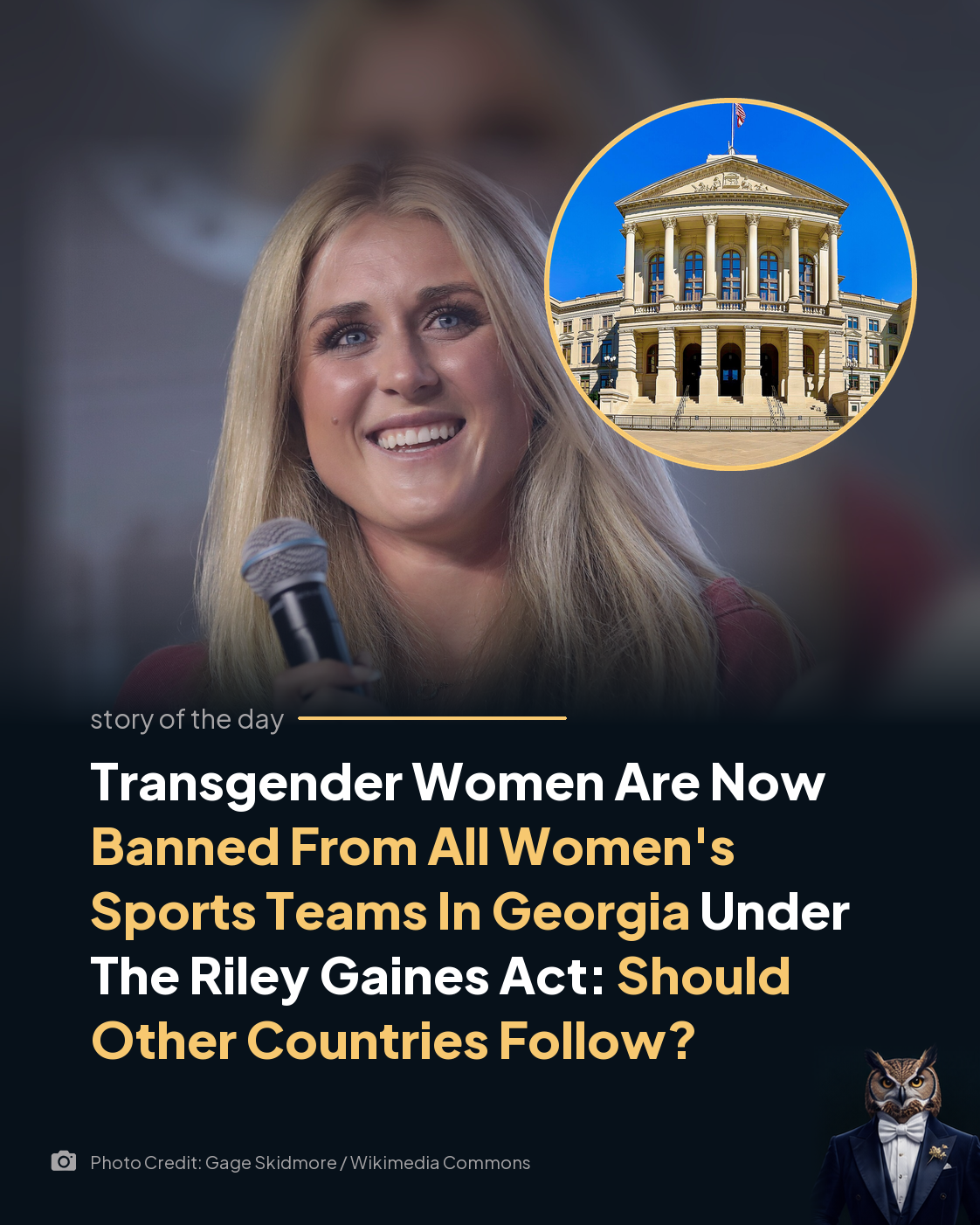
The law is known as Senate Bill 1. It bars students born male from joining school and college teams designated as female. It also bars students born female from joining male teams, with an exception when no female team is offered.
The law covers public schools and colleges, and private ones that take part in the same competitions. Reports describe the ban as starting in sixth grade. It also requires schools to designate restrooms, changing rooms and sleeping quarters by sex.

Schools that willfully ignore the law can lose state funding, including money for scholarships, loans and grants. The law also allows lawsuits and monetary damages against institutions that do not comply. Reports said it takes effect on July 1.
The Senate passed the bill 35 to 17, and the House approved it 100 to 64. Kemp called it “commonsense legislation” about what is “fair and safe for our children”. House Speaker Jon Burns said the issue is not partisan and “it’s about right and wrong”.

The bill is named for Riley Gaines, a former Kentucky college swimmer. She lost to a transgender competitor at an NCAA event held at Georgia Tech, according to reports. She has since become one of the best-known voices for limiting women’s sports to biological females.
Supporters say the law protects fairness and safety. Frontline Policy Action, a Christian advocacy group that helped draft the bills, argued that differences in physical strength make mixed competition unfair and dangerous. They say girls should not have to compete for podium spots and scholarships against athletes who went through male puberty.

Critics say the law is far bigger than the problem. They note that no evidence was presented of significant issues in Georgia’s elementary or high schools. LGBTQ Nation reported that Georgia had no transgender student athletes playing at the time.
They also point out that the law carries the name of an athlete from another state. For them, it looks like a national political message more than a local solution. Transgender students and their families say the ban singles out a small group of young people.

One detail in the headline needs care. The law applies to school and college teams, not to every women’s team in the state. Community leagues and private clubs that do not compete against schools are not clearly covered.
The debate is not only American. In March 2026, the International Olympic Committee adopted a policy limiting its female category to biological females. Reports say the policy relies on a one-time SRY gene screening and takes effect for the 2028 Los Angeles Games.

The IOC policy is reported not to apply to grassroots or recreational sport. It also affects some athletes with differences in sex development. Those details show how complicated any single rule can become.
World Athletics introduced a one-time SRY gene test for female athletes before the 2025 World Championships in Tokyo. World Athletics and World Aquatics have also barred transgender women who went through male puberty from elite female competition. Reports say some other federations, including rugby union, have similar rules.

So the Georgia law is part of a wider trend rather than a lone outlier. Many sports bodies already limit the female category in some way. The main difference is that Georgia put its rule into state law and tied it to public funding.
Countries are not the same, though. Each has its own laws on equality, education and sport. A rule that works through school funding in the United States may look very different in Europe, Asia or Africa.

Governing bodies usually set the rules for elite and international competition. Governments set the rules for schools and public facilities. Any country thinking about following Georgia would have to decide which of those it wants to change.
Supporters of wider bans say consistency would remove confusion. An athlete would face the same rule at school, at university and at the Olympics. They say clear categories help coaches, referees and young athletes plan ahead.

Opponents say sweeping national bans go too far. They argue that eligibility should be decided sport by sport, using evidence about performance and safety. They also worry that strict rules can lead to invasive checks on any girl who does not fit a stereotype.
Some middle-ground ideas have been floated as well. These include open categories, mixed events and case-by-case review. Each has its own costs, and none has won universal support.

The Georgia law has also drawn a political reaction beyond sports. Supporters call it a promise kept to female athletes. Opponents call it a harm done to vulnerable kids.
So should other countries follow Georgia’s lead? Would you want your own country to write a ban into law, or leave the decision to sports federations? There are serious arguments on both sides.

Tell us what you think in the comments. Do you want sports to be decided strictly by biology, or to leave room for case-by-case rules? We would like to hear respectful views from every perspective.