

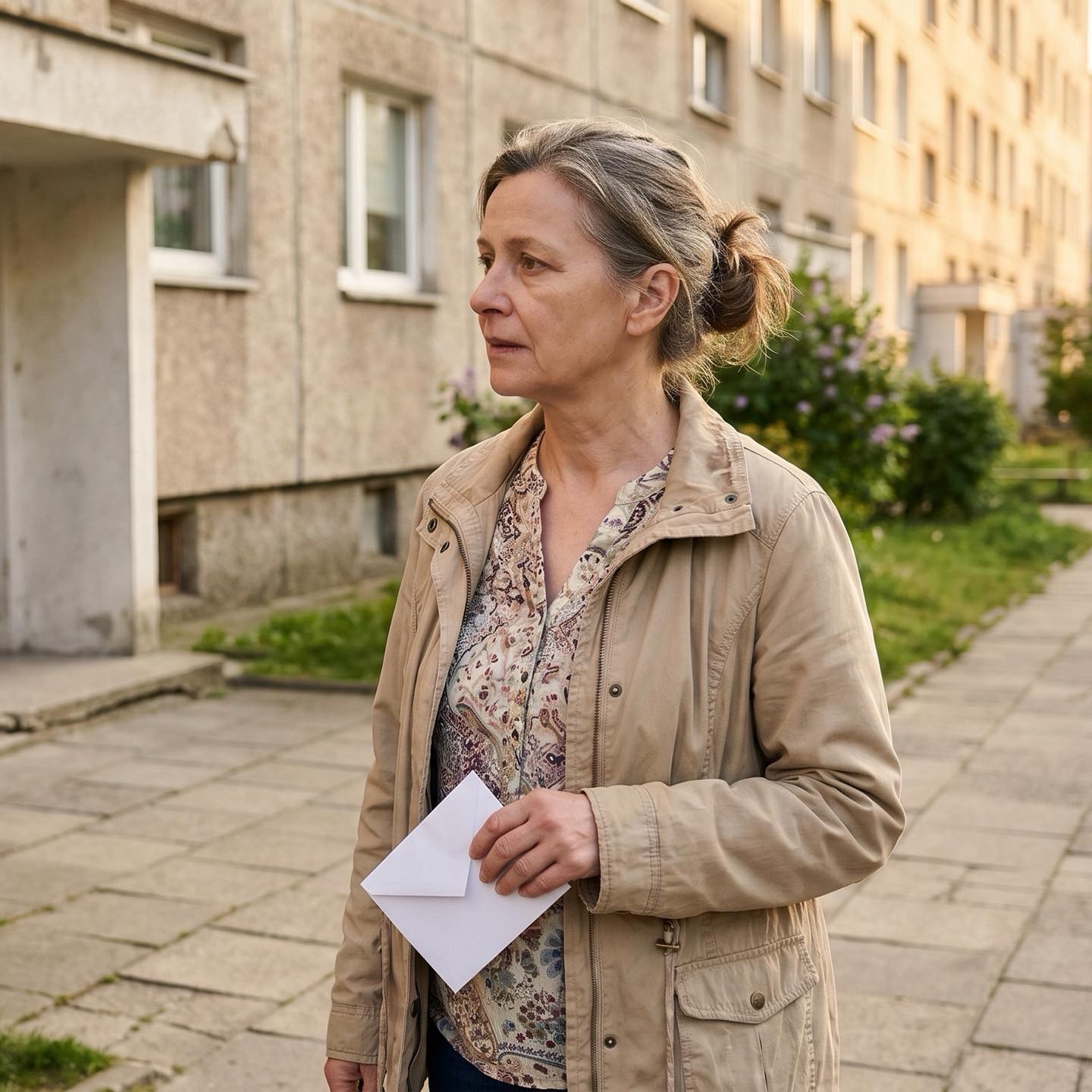
There are certain moments after which the world looks exactly the same—the same walls, the same clock on the wall, the same line at the office—but you know that nothing is the way it was before. For me, one of those moments was the question asked by the transportation department employee:
“Which vehicle would you like to deregister? The Opel Astra or the Ford Focus?”
Bartek looked at me. I looked at him. Neither of us knew anything about a Ford.
Grzegorz died in February, peacefully, in his sleep, just as he had lived—without making a fuss. Thirty-two years together, and until the very end I couldn’t tell whether he was a quiet man or simply someone who buried everything deep inside himself.
I own a small sewing supplies shop on Kopernika Street in Olsztyn. I’ve stood behind the same counter for twenty years, and I know every customer by name. Grzegorz used to drive trucks, traveling all over Poland for years, then shorter routes, and toward the end only around Warmia and Masuria.
He never complained. Neither did I.
We had Bartek, we had paid off the apartment, and we had our routines—morning coffee, Sunday walks, Christmas Eve dinners just the two of us after our son moved away.
After the funeral, what remained was what always remains—paperwork. Bartek took time off work and helped me handle all the formalities. Social security, the bank, insurance. Finally, the car—the Opel Astra Grzegorz had driven around town for years.
We went to the transportation office.
“One Opel Astra, model year 2011, and one Ford Focus, model year 2008. Which one are we deregistering?”
“Which Ford?” Bartek leaned over the counter.
“The Ford Focus registered at…” the clerk glanced at the screen, “14 Dworcowa Street, Apartment 23.”
Dworcowa Street.
The neighborhood behind the train station. Those old four-story apartment blocks from the 1980s. Grzegorz had never mentioned that address. He had never known anyone there. Or so I thought.
“Maybe it’s some kind of system error,” Bartek said in the car on the way home.
He said it in a tone I knew well—the tone people use when they say something they don’t believe because the silence would be worse.
I didn’t answer.
I sat there holding the piece of paper on which I had written the address, feeling as if it were burning my fingers all the way home.
For three days I carried that address in the pocket of my apron. I went to the shop, served customers, measured buttons, handed out thread, smiled when necessary, and all I could think about was:
14 Dworcowa Street. Apartment 23.
Grzegorz drove trucks. Which meant he left. Then he came back. Then he left again. Then he came back.
For twenty years that rhythm defined our lives.
I knew when he left, but I rarely knew exactly where he was. I didn’t keep track of him. I didn’t call him every hour. I trusted him.
Or—now I see it more clearly—I didn’t want not to trust him, because that would have required a kind of courage I wasn’t ready for.
On the fourth day, I went to Dworcowa Street.
An apartment building like any other.
The stairwell smelled of paint and someone’s dinner. Second floor. Door number 23. A doormat with the word “Welcome” written on it.
I rang the bell.
A woman opened the door.
About forty-five years old, maybe younger. Short black hair, a tired face, but not an old one. She wore a tracksuit and wool socks.
Behind her, in the narrow hallway, stood a folded wheelchair leaning against the wall.
“Hello?” she asked.
Then something flickered in her eyes and disappeared again, as if she recognized me, even though I was certain we had never met.
“My name is Celina,” I said. “I’m Grzegorz’s wife.”
The silence lasted perhaps three seconds, but each one stretched out like an hour.
“Please, come in,” she finally said.
Her name was Agnieszka.
She made tea in silence, set a mug in front of me with the words “Wonderful Mother” printed on it, and sat down across from me.
The apartment was small, clean, and smelled of laundry detergent.

