

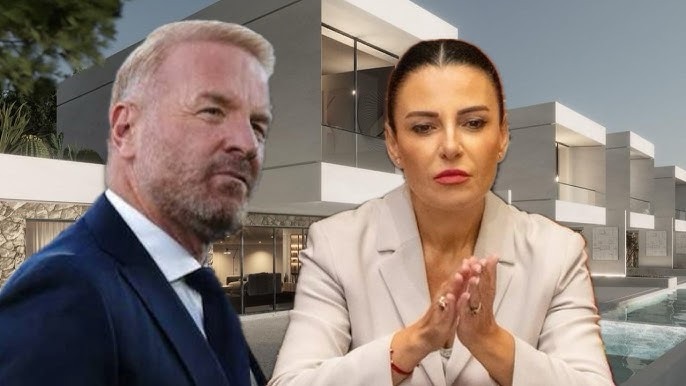
Igli Tare and Joana Bushi as “Nominees” / How Belinda Balluku Allegedly Hid a Villa in Dhërmi
We all applauded him on the football field when he wore the Albanian national team jersey. But today, this report is not about the football player. It is about citizen Igli Tare, brother of Agron Tare, who has held several high-ranking positions in the Albanian administration and the Council of Ministers.
It should be recalled that when Tare registered the company that obtained state-owned land in Fier, his brother was serving in a very important position as Director General of the Port Authority of Durrës.
Before Belinda Balluku was appointed Minister of Infrastructure and Energy in December 2018, Igli Tare was not engaged in any particularly profitable business activity in Albania. However, everything began to change as Balluku climbed to the highest levels of power.
According to this investigation, Igli Tare and Belinda Balluku have maintained a close relationship since 2014, and it is up to SPAK to determine whether the launch and growth of Tare’s businesses were linked exclusively to Balluku.
One thing is certain: the success of these businesses, whether in construction or the energy sector, falls precisely within the areas regulated by Balluku’s ministerial authority.
While Tare continued to achieve financial success in Albania, Belinda Balluku publicly congratulated him for his accomplishments in what he knows best—football.
Returning to the investigation, in December 2018 the company Agro Roma was established and officially registered with the National Business Center (QKB) on January 25, 2019. The company’s administrator was Aleksandra Tare, Igli Tare’s mother, born in 1951.
The first financial statement submitted to the QKB was for the year 2020. According to that statement, the company operated in the construction sector, employed only one worker, declared no revenue, but reported liabilities to its shareholder exceeding €300,000 at today’s exchange rate.
This indicated that the company had incurred significant expenses, leading investigators to suspect these costs were related to obtaining construction permits.
In January 2021, Soni Agalliu, a cousin of Igli Tare, was appointed administrator. In the 2021 financial statements, those suspicions appeared to be confirmed.
Agro Roma 2019 reported construction inventory worth approximately 99 million lekë, equivalent to around €990,000 at today’s exchange rate, compared to roughly €790,000 the previous year.
At that time, the company’s only employees were Soni Agalliu and Aleksandra Tare, Igli Tare’s mother.
The investigation further revealed that Edi Rama and Belinda Balluku had approved a construction permit for this company in one of Tirana’s most valuable areas.
Construction Permit:
“Mixed-use development including services, hotel facilities, and residential units,” located near Zogu i Zi, Tirana.
In 2023, Agro Roma 2019 absorbed another company, Real Eco Energys sh.p.k., founded by Edi Agalliu, the father of administrator Soni Agalliu.
According to its registered business purpose, Real Eco Energys had been established to develop a photovoltaic solar park. This is evident both from its name and from its business activities throughout its existence.
After obtaining the necessary permits, the company was merged into Agro Roma 2019 through an absorption procedure. As a result, Agro Roma became the owner of both the company and the photovoltaic park that had been approved under the authority and signature of Belinda Balluku.
According to the company’s 2022 financial statements, Agro Roma 2019 reported liquidity of approximately €1.6 million. The company also declared receivables from Navitalia amounting to 12.7 million lekë (around €120,000), suggesting that financing or construction work had been carried out for that company.
Navitalia is another company co-founded by Igli Tare in 2019, focused on agritourism activities.
At the same time, the inventory and work-in-progress category had reached approximately €1.6 million.
The company also reported expenses related to the 8% infrastructure tax, amounting to around €200,000. According to the investigation, this demonstrates that the company, despite having no significant prior business activity, had already benefited from construction permits granted by public authorities.
The financial statements further indicate expenditures related to project preparation and applications for a photovoltaic park with a capacity of under 2 MW.
The liabilities section shows that the company owed approximately €1.5 million to its shareholder, while advance payments from apartment buyers had reached around €2.2 million.
Following the merger with Real Eco Energy, revised financial statements were submitted to the National Business Center, reflecting increased liquidity and higher expenditures.
On September 1, 2023, the company changed its registered business address to:
“Tirana – Construction permit issued by the National Territorial Council (KKT), Decision No. 07, dated June 10, 2021, cadastral zone 8210, near Zogu i Zi.”
According to the shareholders’ decision regarding the change of address, the permit was officially approved in June 2021, even though construction activities and invoicing had allegedly begun in 2020.
The same trend continued in the 2023 financial statements.
By 2024, the company reported advance payments from apartment buyers totaling approximately €6 million.
The investigation argues that the company’s activity appears to be driven primarily by permits obtained for construction projects and photovoltaic developments rather than by traditional real-estate business operations.
Official records indicate that the company first received a development permit from then-Mayor Erion Veliaj on November 19, 2020, and paid the 8% infrastructure tax on November 25, 2020.
According to the permit documentation, the developer was Agro Roma.
In June 2021, the National Territorial Council, under the signatures of Edi Rama and Belinda Balluku, approved another construction permit near Zogu i Zi for Agro Roma 2019.
Under the revised permit, the project was expanded from a residential complex to include hotel facilities as well.
Permit Revision:
“Soho Towers” – a mixed-use development including services, hotel facilities, and residential units, located near Zogu i Zi, Tirana, with Agro Roma 2019 sh.p.k. as the developer.
In 2024, another revision of the construction permit was approved for the same “Soho Towers” project.
To support the development, Igli Tare established a new company, Soho Investment Partners sh.p.k., in February 2024.
The company’s administrator was Teuta Agalliu, the mother of Soni Agalliu and a relative of Igli Tare.
According to salary records from 2021, Teuta Agalliu was employed as an analyst at FSHU, an institution operating under the authority of the Ministry of Infrastructure and Energy.
The investigation raises a number of questions.
It asks whether this is the same building referred to in recorded conversations involving Belinda Balluku and Evis Berberi; whether this is the project where apartment prices were allegedly discussed at no less than €3,000 per square meter; and whether construction permits were signed while Balluku was staying at the White Rocks resort in Dhërmi.
The report concludes that these are questions that SPAK should ultimately answer through its investigation.
While construction permits were being approved through decisions signed by Belinda Balluku and Edi Rama, the investigation alleges that other benefits were also being granted through local government authorities.
According to a report by the Albanian Supreme State Audit Institution (KLSH), serious irregularities were identified in the procedure through which Agro Roma 2019 obtained approximately 3.3 hectares of state-owned land in Sheq Marinas, Fier.
The lease agreement between Agro Roma 2019 and the Municipality of Fier was signed on May 27, 2022, with a duration of 20 years. The land area involved measured approximately 33,000 square meters.
According to the KLSH audit report, this land was leased without prior approval from the Municipal Council of Fier, as required by law.
The report notes that the lease agreement referenced Municipal Council Decision No. 101, dated December 19, 2017, concerning the leasing of several plots of land in Sheq Marinas. However, auditors concluded that the specific parcel leased to Agro Roma 2019 was not among the properties included in that decision.
As a result, the audit suggested that the legal basis used for the lease may have been improperly applied.
The KLSH report further stated that several required administrative procedures were allegedly not followed, including the establishment of a working group to evaluate the application and the preparation of documentation related to pricing and valuation.
According to the auditors, responsibilities that normally belong to the Ministry of Economy may also have been bypassed during the process.
The report additionally notes that the lease agreement was signed for a period of 20 years, while the applicable legal framework allegedly provided for a maximum duration of 10 years.
Following the signing of the preliminary agreement in December 2020, Belinda Balluku’s ministry granted preliminary approval for the construction of a photovoltaic power plant on December 30, 2021.
Subsequently, in 2022, the Municipality of Fier finalized the lease agreement with Agro Roma 2019.
In May 2023, the National Territorial Council approved a development permit for the photovoltaic project.
Development Permit:
“Construction of a photovoltaic electricity generation facility with an installed capacity of 2 MW, together with supporting infrastructure, located in the Municipality of Fier, with Agro Roma 2019 sh.p.k. as the developer.”
The investigation further notes that Agro Roma 2019 reportedly received consulting services from A2 Partners & Law, a company founded in January 2020 by Aulona Xhafaj.
According to the report, A2 Partners & Law provided professional consulting services related to the project.
The investigation raises questions regarding connections between individuals involved in energy projects in the Fier area and whether certain investors may have benefited from favorable treatment in obtaining permits.
It suggests that these matters warrant further examination by law enforcement and judicial authorities.
The report concludes that these developments are among the issues that SPAK may need to examine in determining whether any criminal offenses were committed and whether public officials improperly influenced permit approvals and business opportunities.
The investigation then turns to what prosecutors claim is one of the most significant aspects of the case: the luxury villa located within the White Rocks resort in Dhërmi.
According to the Special Anti-Corruption Prosecution Office (SPAK), former Deputy Prime Minister Belinda Balluku is under investigation and has been charged in connection with public procurement procedures, while prosecutors have also expanded the investigation to include allegations of passive corruption and money laundering.
SPAK states that additional evidence gathered through special investigative methods, digital evidence, and other materials has led investigators to suspect the commission of new criminal offenses.
The case centers on a public procurement procedure involving the reconstruction of Albcontrol’s technological building, with a contract value exceeding 88 million lekë, as well as a subsequent contract extension worth more than 14 million lekë.
According to prosecutors, officials involved in the tender allegedly predetermined the winning company and created unfair advantages during both the tendering and implementation phases.
SPAK alleges that Belinda Balluku, while serving as Director General of Albcontrol, received an improper benefit in exchange for favoring the company Eurocol sh.p.k. during the procurement process.
According to investigators, that benefit consisted of a villa identified as Villa F6, located within the White Rocks tourist resort in Gjilekë, Dhërmi.
The villa was reportedly valued at approximately €145,000 under the relevant purchase agreement.
SPAK claims that evidence suggests the villa was requested and obtained as an improper benefit connected to the public procurement procedure.
The prosecution further alleges that efforts were made to conceal the true ownership of the property through a series of legal transactions that investigators consider fictitious.
As part of the investigation, the Special Court approved the preventive seizure of the villa on June 3, 2026.
The property consists of a two-story villa with a surrounding plot of approximately 300 square meters, together with parking facilities and other amenities.
According to SPAK, ownership was allegedly concealed through agreements involving Igli Tare and Joana Bushi.
Investigators claim that a purchase agreement signed in December 2018 between Igli Tare and representatives of Eurocol was not intended to reflect the true beneficial owner of the property.
The prosecution also refers to a private rental agreement signed in May 2022, as well as a later amendment signed in April 2024, which prosecutors believe were part of an effort to disguise the actual ownership and use of the villa.
SPAK alleges that Belinda Balluku, Igli Tare, and Joana Bushi participated in these arrangements.
According to witness statements collected during the investigation, employees responsible for maintaining the property stated that they regularly observed Belinda Balluku and her family using the villa, while they reportedly never saw Igli Tare residing there.
Investigators also claim that the furnishing and decoration of the villa were managed by Balluku and individuals close to her, rather than by Tare.
Digital evidence, including messages, photographs, and voice communications, is said to support those findings.
The investigation further notes that although Igli Tare was listed as the owner, he allegedly never personally occupied the villa.
Several years after the purchase agreement was signed, a private rental agreement was reportedly concluded under which Joana Bushi became the tenant.
According to SPAK, investigators found no clear evidence of rental payments being transferred through formal banking channels.
Prosecutors therefore argue that the arrangement may have lacked genuine economic substance.
Based on the evidence collected so far, SPAK considers the villa to be indirectly owned by Belinda Balluku and has treated it as a suspected product of corruption and money laundering.
The criminal proceedings remain ongoing, and the final determination of criminal responsibility will ultimately be made by the courts following the completion of the judicial process.

