

The check for one hundred twenty million dollars hit the mahogany desk with a sharp snap that echoed through the silent study.
My father-in-law, Arthur Sterling, patriarch of the multi-billion dollar Sterling Global empire, did not even look at me when he spoke.
“You are not a fit for my son, Nora,” he said, his voice cold and clinical, like a doctor delivering a terminal diagnosis. “Take this. It is more than enough for a girl like you to live comfortably for the rest of your life. Just sign the papers and disappear.”
I stared at the staggering string of zeros printed across that slip of paper.
One hundred twenty million dollars.
More money than most people would see in ten lifetimes.
My hand instinctively moved to my stomach, to the slight, almost imperceptible bump hidden beneath my coat.
A secret I had been holding for three days. A secret I had been waiting for the right moment to share with my husband.
That moment would never come now.
I did not argue. I did not cry. I did not beg for another chance or plead for Julian to remember the vows we made three years ago.
I picked up the pen, signed the divorce papers with my maiden name, took the money, and vanished from their world like a raindrop into the ocean.
Silent. Traceless. Forgotten.
Or so they thought.
Five years later, the eldest Sterling son was hosting what the society pages were calling the Wedding of the Decade at the Plaza Hotel in Manhattan.
The air was thick with the scent of imported lilies and old money. Even the crystal chandeliers seemed to vibrate with opulence, casting fractured light across marble floors that gleamed like mirrors.
Women in designer gowns worth more than houses whispered behind gloved hands. Men in custom suits discussed mergers and acquisitions over champagne that cost more per bottle than a month of rent.
This was the world I had been told I did not belong in.
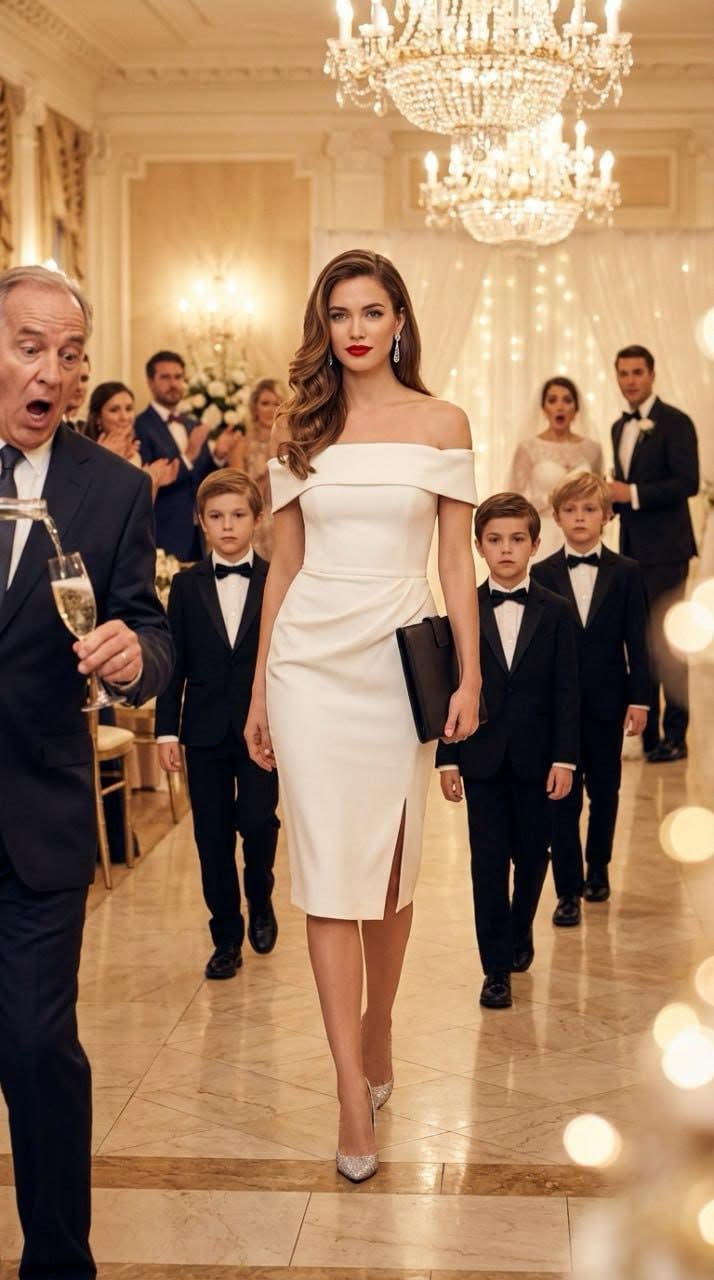
I entered the grand ballroom in four-inch stilettos, black and sharp as knives.
Each step echoed against the marble floor, deliberate, calm, and proud.
Behind me marched four children, a set of quadruplets so identical they looked like perfect porcelain copies of the man standing at the altar.
Four pairs of green eyes, the same shade as Julian Sterling’s.
Four heads of dark hair with that distinctive Sterling wave.
Four children dressed in matching navy suits and dresses, walking with the kind of confidence that comes from knowing exactly who you are.
In my hand was not a wedding invitation.
It was the initial public offering filing for a tech conglomerate recently valued at one trillion dollars.
My company.
The moment Arthur Sterling’s eyes met mine across that crowded ballroom, his champagne flute slipped from his fingers.
It shattered against the floor, the sound cutting through the string quartet like a gunshot.
The room fell silent.
My ex-husband, Julian Sterling, froze center stage, his hand still holding that of his bride-to-be.
The smile on her face turned to ice, fragile and brittle, looking as though it might shatter with a single touch.
I held my children’s hands and smiled.
A serene, terrifyingly calm smile.
I did not need to say a word. The silence that followed spoke for me.
The woman who left with nothing was gone.
The woman who returned today was the storm.
Let me take you back to where it all began.
Three years before that check landed on the desk, I was a twenty-four-year-old graduate student at Columbia, studying applied mathematics and barely making ends meet.
I tutored rich kids on the Upper East Side to pay my rent. I lived on instant noodles and coffee. I wore the same three outfits on rotation.
I was nobody.
Julian Sterling was everybody.
Heir to a fortune so vast it had its own Wikipedia page. Handsome in that effortless way wealthy men are, with tailored suits that fit like second skin and a smile that had launched a thousand magazine covers.
We met at a charity gala I was working as a coat check girl.
He asked me my name. I told him. He asked me to dinner. I laughed and said I could not afford the restaurants he probably went to.
He showed up at my apartment the next day with takeout Chinese food and a bottle of wine that probably cost more than my entire wardrobe.
We ate on my fire escape, legs dangling over the city, and he told me he was tired of people who only saw his last name.
I told him I did not care about his last name. I cared about whether he could solve a differential equation.
He could not.
I fell in love anyway.
For six months, we lived in a bubble. He took me to places I had only seen in movies. I showed him parts of the city tourists never found.
He said I made him feel real.
I said he made me feel seen.
When he proposed, it was not with a ring the size of a small country. It was with his grandmother’s simple gold band, sitting on a bench in Central Park at sunrise.
I said yes because I loved him.
I should have known better.
The wedding was small by Sterling standards, which meant only three hundred people and a reception that cost more than a modest house.
Arthur Sterling did not smile once during the ceremony.
He shook my hand at the reception and said, “Welcome to the family, Nora. I hope you understand what you have gotten yourself into.”
I thought he was being dramatic.
I was wrong.
The first dinner at the Sterling Estate in Greenwich happened three days after we returned from our honeymoon in Italy.
I returned after dark, still jet-lagged and disoriented. The mansion was ablaze with light, looking more like a fortress than a home.
In the formal dining room, the table was set with a spread fit for royalty. China so delicate it looked like it might dissolve if you breathed on it. Crystal glasses that caught the light like tiny prisons. Silver so polished you could see your reflection.
But no one was eating.
At the head of the table sat Arthur. He did not need to raise his voice to command the room. His silence was heavy enough to choke the air out of your lungs.
To his left was Julian. He was leaning back in his chair, scrolling through his phone, his handsome profile carved in cold indifference.
It was as if he were waiting for a boring meeting to end, rather than having dinner with his new wife.
I changed out of my travel clothes and walked toward the table, heading for the empty seat next to Julian.
“Sit at the end,” Arthur commanded, his voice sharp enough to cut glass.
He pointed to the far edge of the long table, the seat reserved for distant guests or low-level business associates.
A seat so far from the others I would need to shout to be heard.
I paused for a fraction of a second, waiting for Julian to say something. To tell his father that I was his wife, that I belonged next to him.
Julian did not even look up. His long fingers flicked across his phone screen, his mind clearly occupied with more important matters than where I sat.
I walked to the end of the table and sat down. The leather chair was ice cold.
A maid silently placed a setting in front of me. I caught a glimpse of pity in her eyes, quickly hidden behind professional neutrality.
I gave her a tiny nod of acknowledgment.
This was the ritual, I would learn. For three years, the Sterling dinners were not about food. They were a theater of power, a constant reminder that I was the uninvited mistress of the house.
“Now that we are all here, eat,” Arthur said.
He took the first bite. Only then did Julian put his phone down to eat with practiced, robotic elegance.
He never looked at me once during that entire meal.
I was a ghost in my own home.
I picked up my fork, but the food tasted like ash in my mouth. My throat felt tight, my stomach churned, but I forced myself to eat.
I knew tonight was different. Arthur’s gaze was sharper tonight, more final, like a judge preparing to pass sentence.
I felt the blade hanging over my head. I did not ask when it would fall. I simply waited.
“Nora,” Arthur said, wiping his mouth with a silk napkin after what felt like an eternity. “My study. Now.”
Julian did not even flinch.
The heavy oak doors of Arthur’s study closed behind me with a sound like a tomb sealing shut.
Arthur sat behind his massive desk like a judge about to pass a death sentence. The room smelled of old leather and expensive cigars.
Behind the desk hung portraits of Sterling men going back five generations. All of them looked down at me with the same cold, assessing eyes.
Julian followed us into the study, but he did not sit. He leaned against a bookshelf filled with first editions, eyes already glued back to his phone.
“Look up,” Arthur snapped at me.
I raised my head, meeting his gaze directly. There was no attempt to hide his contempt.
“Nora, it has been three years since you married into this family.”
“Yes, sir,” I whispered, my voice barely audible in that cavernous room.
“You know how Julian has treated you. You know your place here. You were a lapse in judgment, a phase he has finally grown out of.”
He opened a drawer in his desk and pulled out a check already written, already signed.
He flicked it onto the desk. It slid toward me, light as a feather, heavy as a mountain.
One hundred twenty million dollars.
“You do not belong in his world,” Arthur said, each word precisely enunciated. “Take this, sign the papers, and disappear. This is enough to keep you and your pathetic family in luxury for the rest of your lives.”
The insult stung like a needle pressed directly into my heart.
My pathetic family.
My father, a high school teacher who worked two jobs to put me through college.
My mother, a nurse who spent thirty years caring for people who could not afford better healthcare.
Pathetic.
My body trembled, but I kept my face neutral. I looked at Julian, searching for a spark of something.
Regret? Guilt? A single memory of the nights we spent together, the promises we whispered in the dark?
Nothing.
He did not even blink. His thumb continued scrolling, scrolling, scrolling through whatever was more important than this moment.
My heart died right there in that study.
Three years of patience and devotion, three years of enduring silent meals and cold shoulders, three years of hoping he would remember why he married me, were reduced to a lapse in judgment worth one hundred twenty million dollars.
I felt a bitter taste rise in my throat and swallowed it down.
I looked at Arthur and, to his visible shock, I did not scream. I did not beg. I did not throw the check back in his face.
I smiled.
A small, calm smile that seemed to unsettle him more than tears ever could.
I placed my hand on my stomach, where four tiny lives were just beginning to take root.
The surprise I had been waiting to tell Julian for three days, ever since the doctor confirmed it with wide eyes and repeated tests.
Quadruplets. Four babies. A medical miracle.
Now, it was a secret I would take with me.
“Fine,” I said.
One word. Calm as a graveyard, cold as winter.
I picked up the pen he had laid out, flipped to the last page of the divorce decree that had clearly been prepared days ago, and signed my name.
Nora Vance.
Not Sterling. Vance.
I never really belonged to them anyway.
I picked up the check, folded it carefully, and slipped it into my pocket.
Then I walked out of that study for the last time.
The air in the study turned to stone as I pocketed that check.
Arthur looked genuinely stunned. He had clearly practiced his angry father-in-law speech for an hour, prepared counterarguments for my tears and pleas.
I had just robbed him of the performance.
Julian finally looked away from his phone. His brow furrowed, a flicker of confusion crossing his perfect features, perhaps even a hint of something darker.
But I did not care.
Whatever emotions he was capable of feeling, they came three years too late.
“I will be out in thirty minutes,” I said.
I left the study and walked up the grand staircase one last time, my hand trailing along the bannister I had polished with my own hands when the staff was overwhelmed.
I went to what had been our bedroom, though Julian had not slept there in over a year.
He preferred his suite in the east wing, far from me.
I did not touch the designer gowns hanging in the walk-in closet, clothes Arthur had bought to make me look presentable at charity functions.
I did not take the diamonds or the pearls or any of the jewelry that came with being a Sterling wife.
I reached into the very back of the closet and pulled out the beat-up suitcase I had arrived with three years ago.
The same suitcase I had used in college, covered in stickers from places I had never been but dreamed of visiting.
I stripped off the expensive silk dress I was wearing and pulled on my old jeans and a white t-shirt.
Clothes that were mine, bought with money I had earned, worn thin from actual life.
As I zipped the suitcase closed, the weight that had been sitting on my chest for three years finally lifted.
My phone buzzed in my pocket.
It was the Sterling family lawyer, a man named Robert who had always looked at me with thinly veiled distaste.
“Ms. Vance, the CEO wants to confirm you have signed the papers?”
“It is done,” I said, my voice steady. “Tell him he got exactly what he paid for.”
I walked down the stairs for the last time.
The living room was empty. They did not even bother to watch me leave.
Perfect.
I walked out the front door of the Sterling Estate, pulling my suitcase behind me.
The night air was cold and clean, washing away three years of suffocation.
I hailed a car using an app on my phone. I did not go to my parents. I did not want them to see me like this, broken and discarded.
They had warned me about marrying into money. They had told me the Sterlings would never accept a girl from Queens whose father taught high school history.
I had told them love was enough.
I had been so young. So stupid.
I checked into a hotel under my maiden name, Nora Vance, and lay in the clean, impersonal bed, staring at the ceiling.
For the first time in three years, I was alone.
For the first time in three years, I could breathe.
The next morning, I woke up nauseated and dizzy.
I had been feeling off for weeks, attributing it to stress, to the constant tension of living in that house.
But something told me to go to a clinic.
I sat in the waiting room, filling out forms under my maiden name, surrounded by other women in various stages of life.
When they called me back, the doctor was a kind woman in her fifties with gentle hands and a no-nonsense demeanor.
She did the examination, then the ultrasound, her eyes widening as she moved the wand across my stomach.
“Ms. Vance,” she said slowly, “when was your last period?”
I told her. She nodded, her eyes still on the screen.
“I need you to stay calm,” she said, “because what I am about to tell you is extremely rare.”
My heart started pounding.
“You are pregnant,” she said. “With quadruplets.”
The room tilted.
“Four babies,” she continued, pointing at the screen. “See? Four distinct heartbeats. This is incredibly uncommon, especially without fertility treatments. But all four appear healthy and strong.”
I stared at the grainy black and white image on the screen.
Four tiny flickering lights. Four heartbeats. Four lives.
Four reasons to never give up.
The doctor printed out the ultrasound image and handed it to me with a warm smile.
“Congratulations, Ms. Vance. You are going to have your hands full.”
I walked out of that clinic in a daze.
I sat on a bench outside the hospital, the ultrasound image clutched in my shaking hands, and finally allowed myself to cry.
Not out of sadness, but out of a fierce, terrifying joy.
These children were not Sterlings.
They would never know the cold indifference of that house.
They would never sit at the end of a table, ignored and dismissed.
They were mine.
I pulled out my phone and looked at a photo I had taken of the check before depositing it.
One hundred twenty million dollars.
Arthur Sterling thought that money was buying my silence, buying my disappearance, buying the erasure of his son’s mistake.
Instead, that money was going to fund something far more dangerous.
My return.
My revenge.
My empire.
I wiped my tears, stood up from that bench, and opened a banking app on my phone.
Within two hours, the entire one hundred twenty million dollars had been moved into a private Swiss account, invisible to domestic eyes, untouchable by Sterling lawyers.
By the time Arthur realized I was truly gone, the trail would be ice cold.
I looked at flights on my phone.
New York held nothing for me now but ghosts and bad memories.
I needed to go somewhere new. Somewhere I could build something from nothing.
Somewhere people were hungry and ambitious and did not care about your last name.
I booked a one-way ticket to San Francisco.
Silicon Valley.
The place where empires were built on nothing but grit, code, and the audacity to believe you could change the world.
I rubbed my stomach gently, feeling the slight curve that would soon become impossible to hide.
“We are going home, babies,” I whispered.
I had enough capital to start ten companies.
I had the brains they always underestimated because I was quiet, because I was kind, because I did not fight back.
And now, I had four reasons never to lose.
Four reasons to build something that would make the Sterling fortune look like pocket change.
Julian Sterling could enjoy his new life, his new bride, his father’s approval.
Because in five years, I was coming back.
Not as the girl who was not good enough.
But as the woman who owned everything.
The Woman They Paid To Disappear Returned Five Years Later Worth More Than Their Entire Family Fortune

The San Francisco sun was blinding as I stepped off the plane, my hand instinctively going to my stomach.
I had moved the one hundred twenty million dollars into that Swiss account within hours of leaving the Sterling house, making it invisible to anyone who might try to track me.
By the time Arthur realized I was gone for good, there would be nothing to follow.
I stood at the airport, looking at a map of Silicon Valley posted on the wall.
This was the place where empires were built from dorm rooms and garages.
Where nineteen-year-olds became billionaires.
Where your background meant nothing if you could code, pitch, and execute.
I rubbed my stomach gently, feeling the slight flutter that I now knew was four tiny lives beginning to grow.
“We are home, babies,” I whispered.
The first three months were the hardest.
I rented a small apartment in Palo Alto, nothing like the mansion I had left behind, but it was mine.
Every morning I woke up sick, my body adjusting to carrying four babies at once.
The doctor had warned me it would be difficult, that I would need to be careful, that quadruplet pregnancies came with serious risks.
But I did not have time to be careful.
I had a fortune to build and only a limited window before my body would no longer allow me to work eighteen-hour days.
I started attending every tech meetup, every venture capital pitch night, every startup event I could find.
I wore my old clothes, the jeans and t-shirts, blending in with the hoodie-wearing founders who lived on energy drinks and ambition.
No one knew who I was.
No one knew I had one hundred twenty million dollars sitting in an account, waiting to be deployed.
I listened. I learned. I studied the patterns of what worked and what failed.
And then I met Marcus Chen.
He was a former Google engineer who had just left to start his own artificial intelligence company.
He had the vision. He had the technical skills. What he did not have was funding.
We met at a coffee shop near Stanford. He pitched me his idea for an AI platform that could predict market trends with unprecedented accuracy.
Most investors had laughed him out of the room, calling it impossible, calling him crazy.
I wrote him a check for five million dollars on the spot.
His hands shook as he held it.
“Why?” he asked. “You do not even know me.”
“I know enough,” I said. “Build something that changes the world. I will handle the rest.”
That was my first investment.
It would not be my last.
Over the next four months, as my belly grew and my body changed, I quietly built a portfolio.
A cybersecurity startup run by two MIT dropouts.
A biotech firm working on revolutionary cancer treatments.
A clean energy company developing next-generation solar panels.
A logistics platform that would eventually disrupt the entire shipping industry.
I did not invest like a traditional venture capitalist, spreading money thin across dozens of companies hoping one would hit.
I invested like a woman who knew what it felt like to be underestimated.
I found the founders no one else would touch. The ones who were too young, too inexperienced, too unconventional.
The ones who reminded me of myself.
And I gave them not just money, but time. Strategy. Connections.
I became the investor every founder dreamed of and no one knew existed.
My pregnancy became impossible to hide by month five.
I was enormous, carrying four babies in a body that was not designed for such a load.
I could barely walk up stairs without getting winded.
But I did not stop.
I attended meetings via video call when I could not travel.
I read pitch decks from hospital beds during monitoring appointments.
I made decisions while hooked up to machines tracking four separate heartbeats.
The doctors were amazed I was still working.
I told them I did not have a choice.
The truth was, the work was what kept me sane.
Every time I felt weak, every time I wanted to call Julian and tell him about the children he would never meet, I looked at my portfolio.
Companies that were growing, succeeding, changing industries.
Proof that I was more than the girl who was not good enough for the Sterling name.
I gave birth at thirty-two weeks, which the doctors said was actually impressive for quadruplets.
Four tiny, perfect babies.
Three boys and one girl.
I named them after scientists and mathematicians, not socialites or dead Sterling ancestors.
Ethan. Oliver. Lucas. And Sophia.
The moment they were placed in my arms, still attached to wires and monitors in the NICU, I made them a promise.
“You will never beg for a place at anyone’s table,” I whispered. “You will build your own table. And everyone else will beg to sit at it.”
The first year was a blur of sleepless nights and impossible juggling.
I hired a nanny, then two, then three.
Not because I did not want to raise my children, but because I had companies to build and limited time to do it.
I worked from home when they were babies, taking calls with a baby monitor in my ear, reviewing contracts while breastfeeding, making million-dollar decisions on three hours of sleep.
People said it was impossible to be a good mother and a successful businesswoman.
I proved them wrong every single day.
By the time the children were two, my portfolio had grown to twenty-seven companies.
Fifteen of them were already profitable.
Eight were on track for initial public offerings.
Four had been acquired for amounts that made my initial investments look like pocket change.
The tech world started to notice.
They did not know my name yet. I had deliberately stayed in the shadows, using shell companies and intermediaries.
But they knew someone was quietly building an empire.
Someone with an uncanny ability to pick winners.
Someone the smartest founders in Silicon Valley wanted to work with.
The financial press started calling me “The Phantom Investor.”
I liked that. Ghosts were hard to kill.
When the children were three, I made my first public appearance at a tech conference.
I walked on stage to give a keynote speech, four hundred people in the audience, cameras from every major publication pointed at me.
I wore a black suit that cost more than the entire wardrobe I had owned as a Sterling wife.
My hair was pulled back severely. My makeup was minimal. I looked nothing like the soft, accommodating girl Julian had married.
I looked like power.
“My name is Nora Vance,” I said, my voice carrying across the silent auditorium. “And I am here to tell you that the old rules of venture capital are dead.”
I talked about investing in people, not just ideas.
About backing founders from unconventional backgrounds.
About building sustainable companies instead of chasing quick exits.
The audience was riveted.
After my speech, I was swarmed by reporters, founders, investors who wanted a piece of what I was building.
One reporter asked the question I had been waiting for.
“Ms. Vance, there are rumors you were previously married to Julian Sterling. Can you comment?”
The room went silent.
I smiled, the same calm smile I had given Arthur Sterling in his study five years ago.
“I was married once,” I said. “It taught me a valuable lesson about building things that cannot be bought or inherited. Now, if you will excuse me, I have companies to run.”
I walked off that stage knowing the message would reach New York within the hour.
Knowing Arthur Sterling would see my name in the financial press.
Knowing Julian would realize the girl he discarded had become someone he could never touch.
It felt better than I had imagined.
The children grew fast, too fast.
By the time they were four, they were already showing the sharp intelligence I had hoped they would inherit.
Ethan was obsessed with how things worked, taking apart every toy to understand the mechanism.
Oliver was the talker, charming everyone he met with a smile that could have sold anything.
Lucas was the thinker, quiet and observant, always three steps ahead in every game.
And Sophia was the leader, organizing her brothers like a tiny general, fearless and bold.
I enrolled them in the best preschool in Palo Alto, not because of the name, but because it encouraged curiosity over conformity.
The other parents at pickup were tech executives, entrepreneurs, venture capitalists.
They knew who I was now. The Phantom Investor had a face.
Some tried to pitch me in the parking lot. I politely declined and referred them to my website.
Others tried to befriend me, sensing opportunity.
I was cordial but distant. I had learned my lesson about trusting people who wanted something from me.
My children did not know about their father.
When they asked, and they did ask, I told them the truth in a way they could understand.
“Your father and I wanted different things,” I said. “He wanted to live in a world I did not fit into. So I built my own world. And that is where you live now.”
“Do we have a grandfather?” Lucas asked once, his serious eyes studying my face.
“No,” I said firmly. “Family is not about blood. It is about who shows up. And I will always show up for you.”
They accepted that. Children are remarkably adaptable when you give them honesty instead of fairy tales.
By the time they turned five, my net worth had crossed ten billion dollars.
Ten billion.
More than Arthur Sterling had made in his entire lifetime.
More than the Sterling family fortune, built over five generations.
I had done it in five years.
The media started calling me the “Tech Titan in Stilettos.”
I hated the nickname, the implication that my gender was somehow noteworthy, but I used it.
If they wanted to focus on my shoes, fine. They could focus on my shoes while I quietly acquired their companies.
Marcus Chen’s AI company went public that spring.
The initial public offering valued the company at fifty billion dollars.
My five million dollar investment was now worth four billion.
He called me from the floor of the New York Stock Exchange, his voice thick with emotion.
“You believed in me when no one else did,” he said.
“You proved me right,” I said. “Now go change the world.”
Three more of my companies went public that year.
Each one was a massive success.
The financial press started asking how I did it, what my secret was.
I never told them the truth.
That I invested in people who had been told they were not enough.
People who had something to prove.
People like me.
Then, in early summer, I received an invitation in the mail.
Heavy cream cardstock, embossed with gold lettering.
You are cordially invited to the wedding of Julian Sterling and Victoria Ashford.
The Plaza Hotel, Manhattan.
I stared at that invitation for a long time.
Victoria Ashford. Daughter of a senator. Graduate of Vassar. Member of the Junior League.
Everything I was not.
Everything Arthur Sterling had wanted for his son from the beginning.
I should have thrown the invitation away.
I should have ignored it, stayed in California, focused on my life.
But I did not.
I called my assistant.
“Book five tickets to New York,” I said. “The Plaza Hotel. And contact my stylist. I need something that will stop traffic.”
“Ms. Vance,” my assistant said carefully, “are you sure about this?”
I looked at the invitation again, at Julian’s name printed in elegant script.
The man who had sat silent while his father paid me to disappear.
The man who never once asked where I went or how I survived.
The man who had no idea he had four children who looked exactly like him.
“I am absolutely sure,” I said.
I spent the next two weeks preparing.
Not just my wardrobe, though I did have a dress custom made, black silk that cost more than a car.
But preparing my children.
“We are going on a trip,” I told them at dinner. “To New York City.”
“Why?” Sophia asked, always direct.
“Because Mommy has some old friends she needs to see,” I said. “And I want you to see where I used to live.”
“Did you like it there?” Ethan asked.
“No,” I said honestly. “But I like who I became after I left.”
The flight to New York was surreal.
My children pressed their faces against the windows, watching the country pass below.
I had booked a private jet, something I could have never imagined when I left this city five years ago with a suitcase and a broken heart.
Now I owned the jet.
We landed at a private terminal. A car was waiting, sleek and black.
The children were excited, chattering about the tall buildings and the noise.
I was calm.
I had played this moment in my head a thousand times.
Walking back into the world that rejected me.
Showing them exactly what they had lost.
We checked into a suite at the Four Seasons, not the Plaza.
I did not want to be anywhere near the wedding venue until the moment I chose.
That night, I put the children to bed early and stood at the window, looking out over Central Park.
Somewhere in this city, Julian Sterling was preparing for his wedding.
Somewhere in this city, Arthur Sterling was celebrating the marriage he had always wanted for his son.
They had no idea I was here.
They had no idea what was coming.
I pulled out my phone and looked at the latest filing.
My tech conglomerate, the umbrella company that held all of my investments, was scheduled to go public in two weeks.
The valuation? One trillion dollars.
The first woman-led company to ever hit that mark.
I smiled, that same calm smile.
Tomorrow, the Sterling family would learn that the raindrop they thought disappeared had become a tsunami.
And there was nothing they could do to stop it.

