

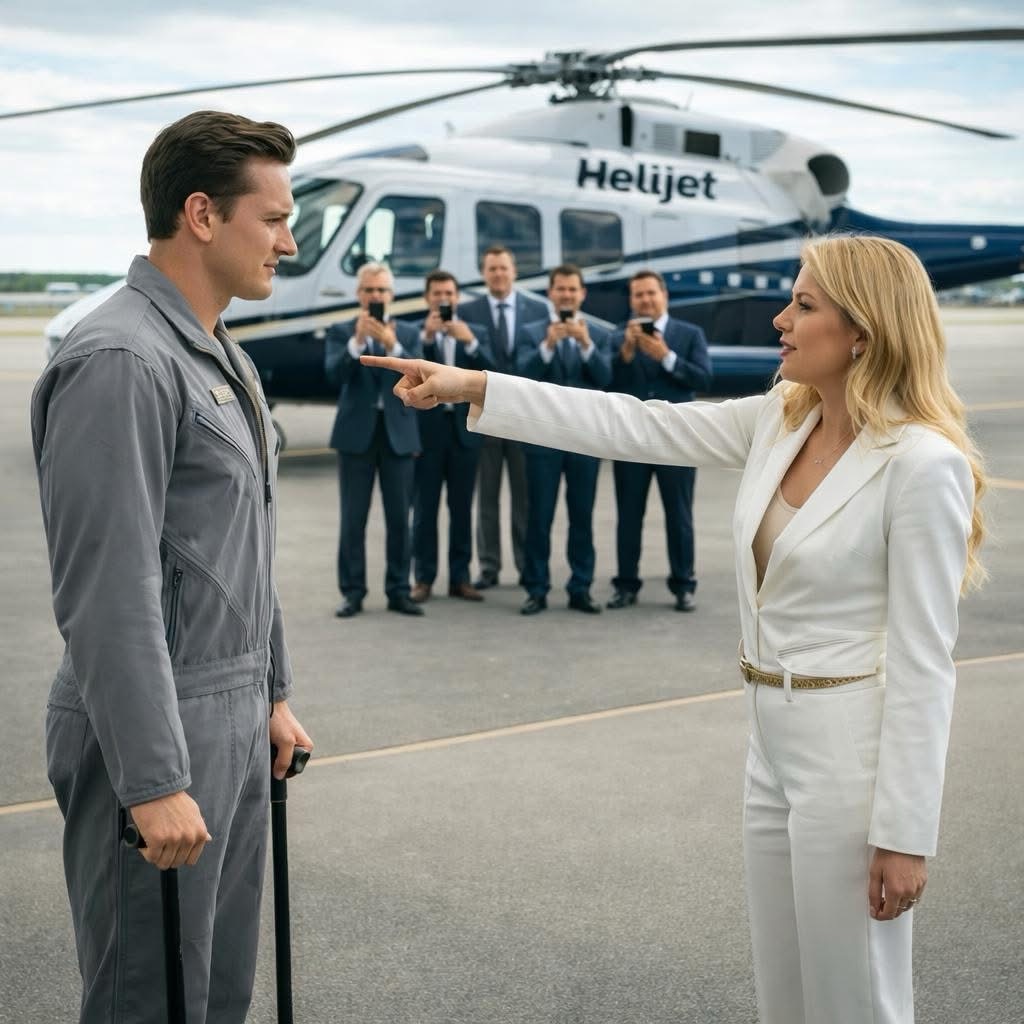
Fly this helicopter and I’ll marry you.”
She said it like it was clever. Like it was entertainment. A little cruelty for the group chat, a punchline to make her engineers laugh and make the janitor feel small.
They didn’t see a man. They saw a uniform. Gray polo, name patch, mop bucket. They saw someone whose job was to erase the evidence of other people’s existence.
They didn’t see the years of service. The wreckage. The grief. The way my life had folded in on itself after my wife died.
They definitely didn’t see that the hands holding a dirty rag used to command birds built for war.
I looked at the helicopter. The Valkyrie V9. Black metal. Sharp lines. Sleek as a predator. Twenty million dollars of carbon fiber and turbine fury sitting under hangar lights like it belonged on a movie poster.
Then I looked at her.
Aurora Sterling, CEO, thirty years old, expensive hair, expensive heels, expensive attitude. The kind of person who wore confidence like armor and used other people’s humiliation as fuel.
She had no idea what she’d just offered.
The smell of ammonia is the hardest thing to scrub out of your skin. It clings. It follows you home. It tells the world exactly where you stand in the hierarchy of who matters.
That’s what my life smelled like now.
I was wiping the glass on the observation deck at AeroSky’s testing facility in Seattle, moving in slow circles, doing my best to be invisible. Invisibility is a skill you learn when you’ve spent too long in rooms full of people who don’t want to acknowledge you.
Head down. Shoulders rounded. Don’t make eye contact with the suits. Don’t speak unless spoken to. Don’t remind them you exist.
My name is Jack Turner. Once, that name meant something in skies over places the news only mentioned when bodies came home. Now it meant “the guy who empties the trash” and “the guy who mops after the engineers spill coffee.”
It had been that way for six months. Six months since I took the job because it was steady, quiet, and didn’t require anyone to ask questions about my limp or the way my hands sometimes shook when I thought too hard about the past.
A voice cut through the hangar, sharp and impatient.
“Pathetic.”
Aurora.
She stood beside the Valkyrie V9, arms crossed, face lit by irritation. Her heels clicked against the concrete, each sound echoing like a gunshot in the open space.
“We launch in a week,” she snapped at a semicircle of engineers, “and not one of you cowards will test the manual override?”
The engineers shifted, eyes dropping to shoes, hands fidgeting with tablets. Brilliant people. Some of the best minds in the industry. Terrified of dying in a machine they built but didn’t trust.
I didn’t blame them.
The V9 wasn’t a toy. It wasn’t a commuter craft. It was a beast that needed a master, not a programmer with perfect fingernails.
I must have stopped wiping for a second too long. My gaze had drifted to the rotor blades, my brain slipping into the old habit of analyzing pitch and weight and angle. Muscle memory. The kind that lives deeper than thought.
Aurora noticed.
Her cold attention landed on me like a spotlight.
“You,” she called. “The janitor. You’re staring like you understand what this is.”
The hangar went quiet in that uncomfortable way it does when people smell entertainment.
Someone snickered.
I tightened my grip on the rag until my knuckles went pale. The ammonia sting rose into my nose, sharp and bitter.
“It’s a beautiful machine, ma’am,” I said, voice rough from not using it much.
“Beautiful?” She laughed, harsh and bright. “Do you think you could handle it? Or is a mop the only stick you know how to operate?”
The laughter grew louder. Phones came out. People leaned in. It wasn’t enough for her to insult her engineers. She needed someone lower. Someone safe to kick.
My mind flashed to my daughter, Maya, at home doing homework at the kitchen table, pretending not to worry about money because she’d learned too early how to read my face.
It flashed to the medical bills stacked on the counter like a monument to my wife’s suffering. Past due stamps. Final notice warnings. Numbers so big they didn’t feel real until they swallowed your sleep.
I swallowed the pride that used to keep me upright.
“I’m just doing my work, ma’am,” I said quietly, turning back to the window.
But Aurora wasn’t satisfied.
She walked toward me, invading my space like she owned it. Expensive perfume. Cold confidence. A manicured finger pointing past my shoulder toward the open cockpit.
“Tell you what, cleaning man,” she announced loudly enough for the cameras. “Fly this helicopter, successfully, and I’ll marry you.”
The hangar erupted.
Someone whistled. Someone laughed too hard. Someone said, “No way,” like the idea of me even touching the aircraft was comedy.
I could feel the heat in my face, the old shame trying to climb back into my skin. But something else was rising too. Not anger exactly. Something sharper.
I looked at her. Really looked.
Under the cruelty, I saw something desperate and frantic in her eyes.
She needed a pilot.
“You’re serious?” I asked.
“Dead serious,” she said, smirking. “But try not to crash it. It costs more than your life.”
That was meant to sting. To remind me of my place.
Instead, it clarified something.
I dropped my rag into the bucket. The plop sounded louder than it should have.
I wiped my hands on my gray pants and walked past her. Past the laughing engineers. Past the phones filming.
I climbed onto the skid of the Valkyrie V9.
The laughter died so abruptly it was almost funny.
I settled into the pilot’s seat like I was stepping back into my own skin after years of wearing the wrong one. The collective fit under my left hand. The cyclic waited under my right. Pedals exactly where my feet expected them.
My body moved before my mind could argue.
Fuel. Hydraulics. RPM limiters. Engine temp. Avionics. Each switch clicked with a satisfaction that made my chest tighten.
The V9 was cutting-edge, fly-by-wire, automated stabilization, digital everything. But underneath the software was the same truth that had kept me alive through sandstorms and enemy fire.
Lift. Drag. Power. Control.
Aurora’s confident smile began to wobble.
I slid on the headset that hung ready. Its padding pressed against my ears. The familiar weight of it made my throat tighten with memory.
“You need to strap in if you’re coming,” I called out without looking at her.
She hesitated. For the first time, she looked uncertain.
“I’m not getting in with…” she started, voice pitching upward.
“Then get everyone clear of the rotors,” I cut in. “This is a hot start.”
A senior engineer named Chen, the only one who’d ever said “morning” to me like I was a human being, stepped forward. “Sir, with respect, the manual override system is untested. The computer should handle—”
“The computer can’t handle crosswinds at altitude,” I said. “It can’t compensate for hydraulic failure. It can’t autorotate if the engine quits. That’s why you need manual override. That’s why you need a pilot, not just software.”
I flipped the battery master switch. The panel lit up.
Aurora’s voice came through the hangar intercom, tight with anger now that she realized she’d lost control of her own joke. “If you damage my helicopter—”
“Then you won’t have to marry me,” I said.
A few nervous laughs popped and died.
I triggered the start sequence.
The turbine whined, rising into that familiar pitch that vibrates in your bones. Rotors turned, slow then faster, the entire airframe shuddering as it woke up.
I closed my eyes for one brief second.
Afghanistan. Heat like fire. Dust and metal and panic. Martinez screaming through the headset. The streak of an RPG in my peripheral vision. The tail rotor taking shrapnel with a crunch I still heard in nightmares.
And then, later, Sarah’s voice on the phone. Crying. Stage four. Six months, maybe.
I’d transferred home. I’d spent those months by her bedside instead of in the sky. When she died, the world went quiet in a way I didn’t know how to survive. Medical discharge. Shrapnel in my back. PTSD. Grounded permanently.
But I never stopped being a pilot.
I opened my eyes.
Rotor at speed. The V9 eager, straining against its own weight.
I pulled collective.
The skids lifted off the hangar floor.
Someone gasped behind me, and the sound was small, almost childlike.
I held a three-foot hover, feeling the helicopter’s personality. She was twitchy on cyclic, sluggish on pedals, like the tuning was wrong. Over-tuned digital responses. Too eager to obey inputs that should have been ignored.
I’d flown worse.
I eased forward into a slow transition, nose dipping, speed building. The hangar doors were already open, someone smart enough to anticipate I might actually do it. I slid through with meters to spare, the rotor wash kicking snow and grit and loose paper into a brief storm behind me.
Seattle stretched out beneath the skids.
Gray water. Bridges. Glass towers. A city that looked calm from above even when people down below were drowning in their own lives.
It had been four years since I’d felt this terrible, wonderful freedom.
I climbed to five hundred feet and leveled out. The V9 hummed beneath me, powerful and precise. I disabled the automated stabilization system, the one everyone was too scared to touch.
The helicopter became more alive immediately. More responsive. More honest.
This was what flying felt like. No translation. No safety net. Just conversation between man and machine.
I banked left. Then right. Tested collective response at different airspeeds. Ran through maneuver patterns that made the software engineers inside the facility probably swallow hard.
The radio crackled.
“What the hell are you doing?” Aurora’s voice. Tight with anger and something else that sounded suspiciously like fear.
“Testing manual override,” I said calmly. “Like you needed.”
“Get back here. Now.”
“In a minute.”
I pushed the V9 harder. Aggressive banks. Quick altitude changes. Recovery drills. The kind of flying that reveals flaws fast.
She performed beautifully. Better than beautifully. Whoever built her had done real work, not just impressive slideshows.
After fifteen minutes, I turned back toward the facility.
I’d made my point.
I brought her in smooth and controlled, set her down so gently the skids barely kissed concrete. Shutdown sequence, one step at a time. Rotors winding down, turbine dropping in pitch, systems darkening.
When I finally removed the headset and climbed out, the hangar was silent.
Forty people stared like they’d just watched the impossible.
Aurora stood at the center of them, expression locked, but her eyes were different now. Less cruel. More unsettled.
I walked up to her, stopping a respectful distance away. My hands still smelled like ammonia, but they weren’t shaking. For the first time in months, they weren’t shaking.
“Manual override works,” I said. “But yaw sensitivity’s too high in the thirty-to-fifty knot range. Collective response drops off above eight thousand feet. And your automated recovery fights manual input instead of complementing it. Fix those three things and you’ve got the best helicopter on the market.”
I turned to leave.
“Wait,” Aurora said.
I stopped.
“Who are you?” she asked, quieter now, like she was afraid of the answer.
“I’m the janitor,” I said.
“No.” Chen’s voice cut in. He’d pulled out his phone and was staring at the screen like he’d seen a ghost. “No, you’re Captain Jack Turner.”
The hangar felt colder.
Chen turned his phone around. A military photo. Me, younger, harder, wearing a flight suit instead of gray polyester.
“Distinguished Flying Cross,” Chen said, awe creeping into his voice. “Two Air Medals. Black Hawk pilot in Iraq and Afghanistan for twelve years.”
I didn’t respond. Medals always felt strange. Like they belonged to someone else. Like they were heavy objects pinned to grief.
“You’re the pilot who landed a damaged Black Hawk in a sandstorm with a dead co-pilot and sixteen wounded onboard,” Chen continued. “They say you flew forty minutes on one engine and half a tail rotor.”
I heard the word dead and felt Martinez’s name press against my ribs like a bruise.
Aurora’s face shifted through shock and mortification and then into something harder, like she didn’t know where to put the shame so she tried to turn it into anger.
“Why are you working as a janitor?” she demanded.
I met her eyes. “Because my wife had cancer. Because medical bills buried us. Because the VA pension doesn’t cover a daughter’s college fund. Because I needed a job that didn’t require flying and you were hiring.”
I let the silence sit.
“And because nobody looks at the janitor,” I added. “Nobody asks questions. Nobody expects anything. I could disappear into the work. Grieve in peace.”
Aurora blinked rapidly, looking away like she hated what she’d just learned about herself.
One of the younger engineers, a woman named Sarah whose name always made something in me tighten, stepped forward. “Those issues you listed,” she said, voice careful. “Would you be willing to consult? Help us fix them?”
“I’m not an engineer,” I said.
“But you know how it should feel,” Chen insisted. “We can make it technically perfect. We need someone who knows what perfect means in the air.”
My mind went to Maya. To scholarship letters. To bills. To the way our air conditioning wheezed like it was one summer away from dying.
“I’ll need to keep my janitor shift,” I said. “I need steady income.”
“We’ll double your salary,” Aurora said suddenly, voice tight as if the words hurt. “Janitor pay plus consulting fees.”
A few people shifted. Someone started to laugh, then stopped.
“And I owe you an apology,” she added. “Several.”
Someone in the crowd muttered, “You owe him a wedding,” and nervous laughter rippled.
Aurora’s cheeks flushed. “I was cruel,” she said. “I was desperate. I was… wrong.” She swallowed. “I’m sorry. Truly.”
“No,” I said calmly. “I didn’t deserve that.”
“The marriage offer was a joke,” she rushed to say.
“Obviously,” I replied. “I wouldn’t marry someone who treats people the way you treated me. Not for any amount of money.”
That landed hard. The hangar went even quieter.
“But I will consult,” I continued, “because that machine deserves to fly right, and my daughter deserves her college fund.”
I walked back to my mop bucket.
It sat exactly where I’d left it. Dirty water gone cold. Rag floating like a surrender flag.
“What are you doing?” Aurora asked, almost bewildered.
“Finishing my shift,” I said. “The windows are only half-done.”
Someone started to protest. Aurora lifted a hand and stopped them.
“Let him finish,” she said quietly. “It’s his job.”
So I finished. I cleaned like the job mattered, because it did. I emptied trash bins, mopped floors, polished glass with the same precision I’d once used to keep people alive.
They pretended not to watch.
When I clocked out at the security desk, Williams, the guard who’d always treated me with respect, looked at me differently now.
“Heard you flew the V9,” he said.
“I did.”
“Heard you used to fly Black Hawks.”
“I did.”
He nodded slowly. “Welcome back, Captain.”
“It’s just Jack,” I said. “And I’m not back. I’m just… here.”
I walked out to my parking lot and got into my fifteen-year-old Honda. Two hundred thousand miles. A dent in the driver’s door where Sarah had backed into a pole during chemo. I’d never fixed it. Didn’t want to erase that last mark of her.
My phone buzzed.
A text from Maya: “Dad, Mrs. Peterson says there’s a video of you flying a helicopter??? CALL ME!!!”
I smiled. First time all day.
I called her.
“Dad!” she answered on the first ring. “Is it true? Did you really fly? Everyone at school is talking about it!”
“It’s true,” I said.
“Why didn’t you tell me you could fly helicopters?”
“It never came up.”
“Dad,” she said, voice softening. “Are you okay? Like, really okay?”
I sat in the car with the key still in my hand, not turning it yet.
“Yeah,” I said, and surprised myself with how true it felt. “I think maybe I am.”
We talked for twenty minutes. Calculus test. Friend drama. College brochures. Normal life. The kind I’d been trying to protect her from losing.
I told her about the consulting pay bump.
“Does this mean we can fix the air conditioning?” she asked hopefully.
“We can fix the air conditioning,” I said.
“And Mom’s gravestone?” Her voice got quiet. “They misspelled her middle name. You said we couldn’t afford to replace it yet.”
My throat tightened. “We can fix that too.”
After we hung up, I sat in the parking lot while the sun sank, painting Seattle in orange and purple. A helicopter passed overhead, distant and indifferent, and I watched it until it disappeared.
Then my phone buzzed again.
An email from an address I didn’t recognize.
“Mr. Turner,” it began. “My name is Richard Castellano, chairman of AeroSky’s board…”
I read it once. Then again, slower.
Chief Test Pilot.
$180,000 salary.
Benefits. Stock options.
A settlement for the humiliation.
Dignity, packaged in corporate language.
I stared at the number until it stopped looking like a hallucination.
Then I typed my reply, hands steady.
No settlement. Not like that.
I wanted a public apology, sincere and recorded. Not just for me. For every person she’d treated like they didn’t matter because they didn’t have her money or her title.
And I wanted AeroSky to hire more veterans.
Because we know how to work. We know how to endure. We know how to keep moving when things get hard.
I hit send.
Then I started my car and drove home to my daughter, knowing the meeting tomorrow would not be about helicopters anymore.
It would be about what kind of company AeroSky wanted to be, and what kind of man I was willing to become again.
The boardroom the next morning looked exactly like it was supposed to look.
Glass walls. Steel accents. Chairs that cost more than my car. A view of Seattle so clean and elevated it made the city feel curated, like a model instead of a place where real people lived and struggled.
I sat at the far end of the table, hands folded, posture straight out of habit. I’d worn the same clean jeans and flannel I always did. No uniform. No suit. Just myself.
Across from me sat Richard Castellano, chairman of the board. Late sixties, silver hair, calm eyes that had seen too many crises to panic over any single one. To his right and left were other board members, men and women with expressions ranging from cautious curiosity to outright discomfort.
And at the far end sat Aurora Sterling.
She hadn’t slept. That much was obvious. Her makeup was minimal, her posture less rigid than the day before. She kept her hands clasped tightly in front of her like she was afraid of what they might do if she let go.
Castellano cleared his throat. “Mr. Turner,” he said, voice measured, “thank you for coming in on such short notice.”
“I was already here,” I replied evenly.
A few board members shifted, not sure whether to laugh.
He nodded. “Fair enough. I want to be direct. Yesterday’s incident has generated… significant attention.” He slid a tablet toward me. “The video of you flying the V9 has crossed eight million views since last night.”
I glanced at the screen. Comments scrolled endlessly. Some praising the flight. Some furious at Aurora. Some calling for her resignation. Some calling me a hero. That last part made my stomach tighten. Heroes are a dangerous label. They erase the mess.
“We’re not here to talk about optics,” Castellano continued. “We’re here to talk about substance.”
He tapped the tablet and another file opened. My service record. Flight logs. Commendations. Medical discharge paperwork. Redacted sections that still looked heavy even blacked out.
“You were honest in your email,” he said. “You don’t want a settlement. You want accountability.”
“Yes.”
“And you want a formal role here,” one of the board members interjected, a woman with sharp eyes and a legal pad already half full. “Chief Test Pilot. Flight Systems Consultant.”
“Yes.”
She leaned back slightly. “You understand that position puts you in direct authority over teams that include senior engineers and executive leadership.”
“I understand,” I said. “I’ve led people who outranked me on paper. The sky doesn’t care about titles.”
That earned a small nod from Castellano.
He turned to Aurora. “Ms. Sterling.”
She inhaled slowly. “I’m here to accept responsibility.”
The room quieted.
She stood, hands still clasped, and looked directly at me. Not past me. Not over me. At me.
“What I did yesterday was wrong,” she said. “It wasn’t stress. It wasn’t pressure. It was arrogance. I used my position to humiliate someone because I felt cornered and afraid.”
She swallowed. “I built a joke out of someone else’s dignity.”
No one interrupted her.
“I judged you by your job,” she continued, voice steady but raw. “I treated you like a prop instead of a person. And when I learned who you were, my first instinct wasn’t humility. It was shame.”
She turned slightly so the rest of the board could see her face. “That’s not leadership. That’s insecurity with power.”
Then she did something none of us expected.
She sat back down.
“I’m not resigning,” she said quietly. “But I am stepping back from day-to-day operations until the board decides otherwise. I’ll comply with whatever corrective actions are required. Including public accountability.”
Castellano studied her for a long moment. “You’ve already recorded the apology?”
“Yes,” she said. “Unedited. No PR review.”
He looked at me. “You asked for that.”
“I did.”
“And you want it released publicly.”
“Yes.”
Another board member leaned forward. “Mr. Turner, are you prepared for what comes with that? You will become the face of this moment. People will project onto you. Expectations will follow.”
I thought about Maya. About the video circulating at her school. About how carefully she’d asked if I was okay.
“I’ve lived with expectations before,” I said. “I can handle them.”
Castellano nodded once. “Then here’s what we’re proposing.”
He outlined it cleanly. Chief Test Pilot. Oversight authority on all manned flight systems. Direct reporting line to the board on safety concerns. Full benefits. Stock options. Veteran hiring initiative written into corporate policy, not marketing language.
“And one more thing,” he added. “We want you to lead the internal safety culture review. Not just of flight systems. Of how people treat each other here.”
Aurora looked up sharply.
“That’s not punishment,” Castellano said calmly. “That’s repair.”
I considered it. The janitor who’d been invisible now being asked to reshape a culture.
“I’ll do it,” I said. “But not alone. You’ll need buy-in.”
“You’ll have it,” he said.
The vote was unanimous.
The apology video went live an hour later.
Aurora sat alone in a plain conference room, no logo behind her, no script in her hand. She spoke clearly. Took responsibility. Named the behavior. Didn’t deflect. Didn’t justify.
The response was immediate and explosive.
Some called it performative. Some called it brave. Some demanded more consequences. But something else happened too.
Emails started coming in.
From custodians. From interns. From engineers at other companies. From veterans.
Stories poured out. Of being mocked. Overlooked. Used as jokes. Reduced to uniforms or titles or pay grades.
One message stuck with me.
“Thank you for not laughing it off. Thank you for standing there and flying anyway. It made me feel like maybe I’m not invisible either.”
That night, I sat at my kitchen table with Maya, pizza boxes between us, my phone buzzing every few minutes.
“Dad,” she said, watching me carefully, “are you scared?”
“A little,” I admitted.
She nodded. “Good. Means you care.”
The next few weeks blurred together.
I traded my mop bucket for a badge that actually had my name on it. I still walked the same halls, but people looked at me differently now. Some with admiration. Some with discomfort. Some with resentment.
That was fine.
I spent my days in flight suits and my evenings on video calls with veterans transitioning out of service. Pilots grounded by injury. Mechanics who missed the rhythm of work. People who still had something to give.
The V9 flew again and again. Each time better. Safer. More honest.
Aurora kept her distance at first. When we did speak, it was professional. Careful. Earnest.
One evening, as the sun dipped low and painted the hangar gold, she stopped beside me while I watched a test flight.
“You didn’t have to stay,” she said quietly. “After everything.”
“I didn’t stay for you,” I replied. “I stayed because the work matters.”
She nodded. “I’m trying to learn the difference.”
I glanced at her. “Learning is a start.”
Six months later, the first class of veteran hires walked into AeroSky’s training wing. Some limped. Some carried scars. Some just looked tired.
They looked like people who’d been waiting to be seen.
Maya visited the facility that afternoon, wearing a sweatshirt from her engineering program, eyes wide as she watched a helicopter lift into the sky.
“That’s yours,” she said.
I shook my head. “No. I just help keep it honest.”
She smiled. “That’s better.”
That night, we drove to the cemetery and replaced Sarah’s gravestone. Fixed the spelling. Polished the stone until it reflected the sky.
I stood there longer than I thought I would.
“I found my way back,” I said quietly. “Just like you said I would.”
The wind moved through the trees, soft and steady. No answer. No need.
Somewhere overhead, a helicopter passed, its sound familiar and comforting.
And for the first time in years, I didn’t feel grounded.
I felt exactly where I belonged.
The first time I walked onto the tarmac as Chief Test Pilot, the smell hit me before anything else.
Jet fuel. Hot metal. Oil. Wind.
It wasn’t nostalgia exactly. It was muscle memory waking up after a long sleep. My body knew where it was before my mind caught up. The weight of the flight suit on my shoulders felt different from the gray janitor’s polo, heavier but familiar, like slipping back into a skin I’d once been forced to shed.
The engineers stopped talking when I approached.
Not out of awe. Out of recalibration.
They were still adjusting to the idea that the man who used to mop behind them now had authority to ground their projects with a single sentence. Some handled it with grace. Others with thin smiles and tight jaws. I didn’t take it personally. Change always makes people uncomfortable, especially when it exposes how wrong they’ve been.
I didn’t come in swinging. No speeches. No victory lap.
I did what I’d always done.
I worked.
I spent hours in the simulator, pushing systems until they failed. I flew test patterns that weren’t flashy but revealing. I asked engineers why a response curve felt off instead of telling them it was. I listened. I explained. I translated the language of fear into the language of physics.
And slowly, something shifted.
Meetings changed tone. People started asking questions instead of defending assumptions. Safety reports stopped being filtered for optimism. Problems surfaced earlier. Fixes came faster.
The Valkyrie V9 became something different under that pressure. Still powerful. Still ambitious. But honest. Predictable in the ways that matter when lives are involved.
Aurora watched all of it from a careful distance.
She wasn’t hiding. She was learning.
The board required her to attend leadership accountability sessions twice a week. No exemptions. No closed-door shortcuts. She showed up without complaint. Took notes. Asked questions that didn’t make her look smart, just sincere.
One afternoon, after a long test cycle, she approached me while I was reviewing telemetry data.
“I used to think leadership meant never showing uncertainty,” she said. “Turns out that’s how you stop people from telling you the truth.”
I didn’t look up from the screen. “Pilots who pretend nothing scares them usually crash.”
She nodded. “I believe that.”
The veteran hiring program launched quietly. No press release. No glossy campaign.
Just interviews.
Men and women with calloused hands and careful posture. People who answered questions directly and didn’t oversell themselves. Pilots who’d lost medical clearance. Crew chiefs who missed the rhythm of purposeful work. Mechanics who still woke up early because their bodies didn’t know how to stop.
They didn’t come in asking for favors.
They came in asking if they were still useful.
They were.
The training wing filled with voices that understood risk without romanticizing it. That respected procedure not because it was policy, but because it kept people alive. The culture shifted in small, cumulative ways.
People started saying “thank you” more.
They started asking custodial staff how their day was going. Not because of me. Because the lie had been exposed, and once you see it, you can’t unsee it.
Maya noticed before I did.
She came home one evening from campus and tossed her backpack onto the couch. “Dad,” she said, “my professor showed your video in class.”
I winced. “The helicopter one?”
“No. The apology one.”
I froze.
“What?”
She smiled, that soft, knowing smile she’d developed over the years. “We were talking about leadership ethics in engineering. Accountability. Power dynamics. Someone raised their hand and said, ‘This reminds me of that AeroSky CEO who apologized to the janitor pilot.’”
I rubbed my face. “That’s… surreal.”
“She said something interesting,” Maya continued. “She said the apology mattered, but what mattered more was what happened after. The structural changes. The hiring policy. The power shift.”
I looked at my daughter, really looked at her, and saw the woman she was becoming. Thoughtful. Sharp. Unafraid to interrogate systems instead of people.
“I’m proud of you,” I said.
She shrugged, embarrassed. “I learned it somewhere.”
We visited Sarah’s grave again that weekend.
The new stone sat clean and correct, her name finally whole. I brushed snow from the base and stood quietly, hands in my coat pockets.
“I didn’t think this was how it would turn out,” I said aloud. “But I think you’d like it.”
The wind moved through the trees, low and steady. The sound reminded me of rotors at idle.
At work, the V9 cleared its final certification flight three weeks ahead of schedule.
No incidents. No surprises. Just a machine doing exactly what it was designed to do because people had finally listened to what it was telling them.
The day of the launch event, Aurora stood beside me on the platform overlooking the runway. Cameras everywhere. Reporters buzzing. The polished version of the company on full display.
“You know,” she said quietly, “if you hadn’t been there that day…”
“If I hadn’t been cleaning windows?” I asked.
She nodded. “This company would be selling a dangerous lie wrapped in good branding.”
“And now?”
“And now,” she said, “we’re building something that deserves to fly.”
The helicopter lifted into the sky right on cue, sunlight flashing off its body as it climbed. Applause broke out around us.
I didn’t clap.
I watched.
Because flying isn’t about applause. It’s about trust.
Later that night, as the crowd thinned and the tarmac cooled, I walked back toward my car. The same Honda. Still dented. Still mine.
My phone buzzed.
An email from a former Army pilot I’d never met.
“Sir, I heard you’re helping vets get back into aviation roles. I lost my medical after an IED. Thought my skills were worthless. Just wanted to say thank you for proving they’re not.”
I sat in the driver’s seat for a long time before responding.
I typed back:
“They never were.”
I drove home under a sky full of moving lights. Helicopters. Planes. People going somewhere.
For years, I’d thought my life had ended when I was grounded. Thought the best parts of me were behind me, buried with medals I didn’t know how to wear and grief I couldn’t outrun.
Turns out, I hadn’t been grounded.
I’d been waiting.
Waiting for the moment someone made a joke that revealed who they really were.
Waiting for the moment I could choose how to respond.
Waiting for the chance to fly again, not for glory or escape, but for purpose.
I’d dropped a rag that day.
Picked up a stick.
And remembered that dignity, once reclaimed, doesn’t just change one life.
It changes the air around it.

