

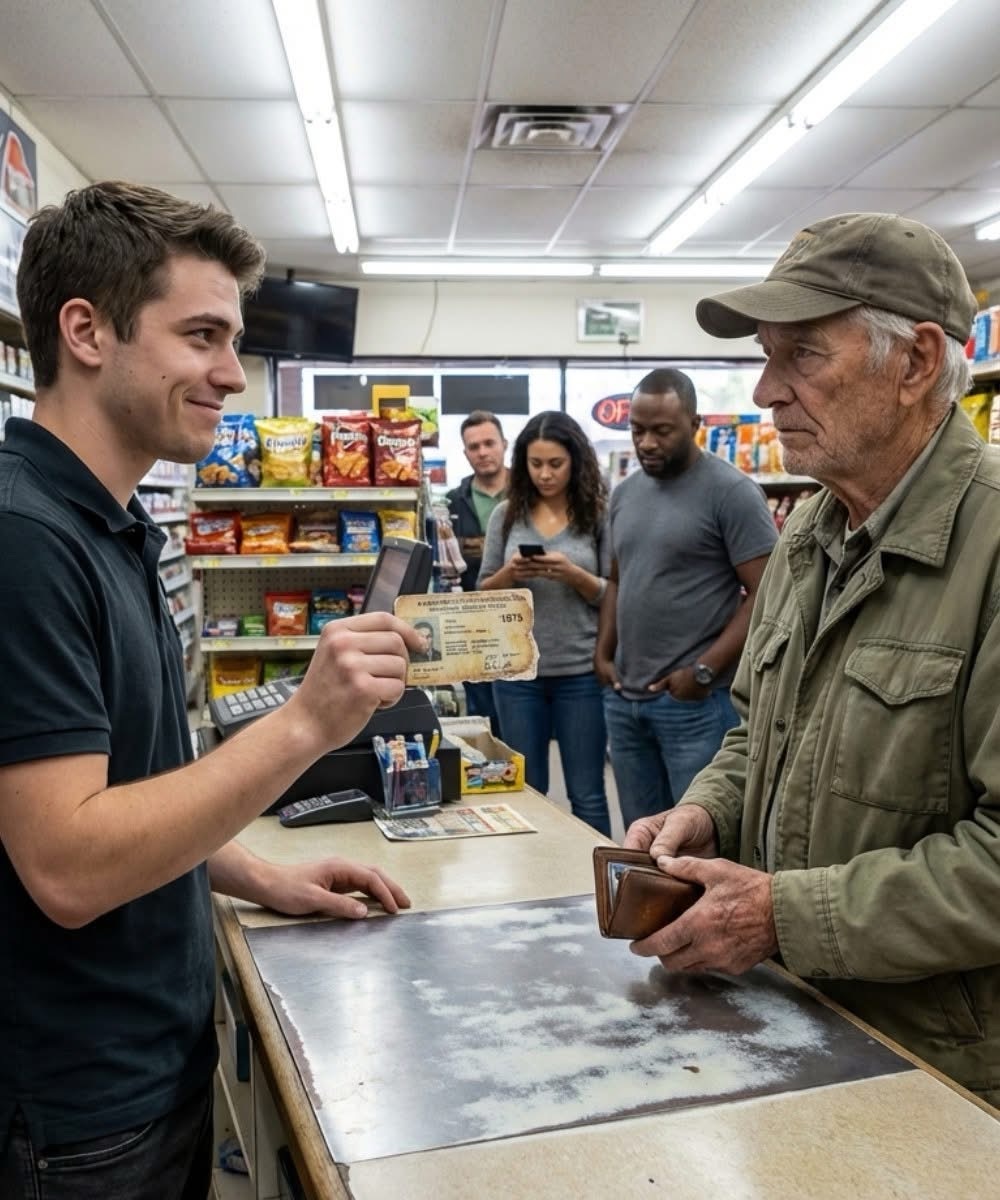
The cashier, a young guy named Kaden, snorted under his breath when he saw the identification card.
“Sir, this ID is from the seventies,” he said, his voice dripping with condescension. “I cannot take this.”
Arthur did not raise his voice. He did not argue. He did not make a scene.
He simply slid the cracked leather wallet back into his pocket with the slow, deliberate care of someone who had learned long ago that patience outlasts pride.
The line behind him shifted and sighed, irritation buzzing in the air like static electricity.
People checked their phones. Someone muttered about being late. A woman tapped her foot impatiently.
“It is a military identification,” Arthur said quietly, his voice steady and calm. “Those do not expire.”
Kaden smirked, a dismissive expression that suggested he had heard every excuse in the book and believed none of them.
“Does not matter. Store rules say valid, current ID only. You want the veteran discount, you play by the rules.” He waved to the next customer, already dismissing Arthur like an inconvenience, like an obstacle to be cleared from his day.
A woman standing behind Arthur in line spoke up, her voice sharp with disapproval.
“He served his country. Just give him the discount.”
Kaden’s jaw tightened, his face flushing slightly.
“Ma’am, policy is policy. I do not make the rules. If you have a problem with it, you can speak to management.”
His tone was clipped, professional in the way customer service workers learn to be when they want to shut down a conversation without being outright rude.
Before anyone could say more, the door to the back office opened with a soft click.
The owner, Vincent, stepped out into the fluorescent brightness of the store.
He was mid-forties, with tired eyes that suggested too many early mornings and late nights balancing books and managing inventory.
He had been reviewing supplier invoices when he heard the raised voices, the tension bleeding through the thin office walls.
He stepped out and instantly sensed the atmosphere, thick with unresolved conflict.
“What is going on here?” Vincent asked, his voice calm but authoritative.
Kaden gestured toward Arthur dismissively, like he was pointing out a stain on the floor.
“He is trying to use some outdated vet card. I told him we need current identification for the discount.”
Vincent’s gaze landed on the card still in Arthur’s weathered hand.
The old man held it carefully, like it was made of glass instead of laminated paper.
Vincent took one step closer, his curiosity piqued.
Then another.
His face drained of color, all the blood seeming to rush from his features at once.
He was not looking at Arthur anymore.
He was staring at the faded photograph on the laminated card, a picture so old it had yellowed around the edges, the colors muted by time.
A young man in military uniform stared back at him, frozen forever at twenty-three years old.
His voice dropped to a whisper, barely audible over the hum of the overhead lights.
“Where did you get this?”
Arthur followed his gaze down to the picture, the image he had looked at thousands of times over nearly five decades.
An impossibly young man with his whole life ahead of him, a man who never got the chance to live it.
“He was my friend,” Arthur said softly, his voice carrying the weight of years.
Vincent swallowed hard, his throat working visibly.
“That man,” he said, his voice unsteady. “His name is George Bennett.”
Arthur nodded slowly.
“Yes.”
Vincent’s carefully maintained composure broke like a dam giving way.
“He was my father.”
The words landed in the space between them like a physical weight, heavy and undeniable.
Arthur stared at him, truly seeing him now, and suddenly the echoes were everywhere.
The same curve of the jaw. The same set of the eyes. The same expression George used to make when he was thinking hard about something.
“He never came home,” Vincent said, his voice breaking. “My mom kept that photo on her nightstand until the day she died. It was the only picture she had of him.”
Arthur placed the card gently on the counter between them, his hands trembling slightly.
He had carried that card for nearly fifty years, through moves and jobs and marriages and loss.
It had been in his wallet longer than anything else he owned.
“I tried to find you,” Arthur said, his voice hoarse with emotion he had been holding back for decades. “But your family name changed. Records ended at your mother. I searched for years, but the trail always went cold.”
Vincent’s eyes filled with tears that he did not bother to hide.
“I was born right before he deployed,” he said. “Three weeks before he left. He never held me. Never heard me cry. Never saw me take my first steps or say my first words.”
Arthur smiled faintly, a sad, distant smile that held fifty years of grief and memory.
“He talked about you constantly. Every single day. Called you little Vinnie. Carried your photo everywhere, right next to his heart. He had this wallet-sized picture of you as a newborn that your mother sent him. He showed it to everyone who would look.”
Tears slid down Vincent’s face, unchecked and unashamed.
The store around them seemed to fade away. The other customers, the humming freezers, the fluorescent lights, all of it became background noise.
“Please,” Vincent said, his voice raw. “Tell me about him. Tell me everything.”
Arthur did.
He spoke of laughter in impossible conditions, of men finding joy in the smallest things because joy was all they had.
He spoke of letters written by flashlight, words carefully chosen because paper was precious and time was short.
He spoke of a man who believed, despite everything he saw, despite the fear and the violence and the constant proximity to death, that he would make it home.
That he would hold his son.
That he would build a life.
“We were pinned down near a creek,” Arthur said, his voice barely above a whisper now, the memory still sharp after all these years. “The ambush came out of nowhere. Your father was hit in the first volley.”
Vincent closed his eyes, but tears continued to slip from beneath his eyelids.
“He knew he was not going to make it,” Arthur continued, his own voice breaking. “He pressed his wallet into my hand. It had your picture inside, and this ID. He said, Find my son. Tell him I loved him. Tell him I tried to come home.”
Arthur’s voice failed him completely.
Silence wrapped the room like a blanket, heavy and suffocating.
Vincent finally spoke, his voice thick.
“He was a hero.”
“Yes,” Arthur said simply. “He was.”
After a long moment, something shifted in Vincent’s expression.
Anger surfaced, hot and immediate.
“I am firing that kid,” Vincent said, turning toward where Kaden stood frozen behind the register, his face pale. “Right now. He disrespected you. He disrespected my father’s memory.”
Arthur stopped him with a gentle hand on his arm.
“No.”
Vincent frowned, confused.
“He disrespected you,” he repeated. “He mocked your service. He deserves to be fired.”
“He did not know,” Arthur said quietly. “He is young. He has not learned yet what these things mean. What they cost.”
He looked over at Kaden, who looked like he wanted to disappear into the floor.
“Teach him,” Arthur said. “Do not punish him. Teach him.”
Vincent stared at Arthur for a long moment, then nodded slowly.
Kaden was called into the office.
He walked in expecting termination, his movements stiff with fear, his hands shaking.
Instead, Vincent slid the military ID across the desk toward him.
“That card belonged to my father,” Vincent said, his voice steady now. “George Bennett. He died in Vietnam in 1971. He was twenty-three years old. He never met me. Never held me. Never came home.”
Kaden’s face collapsed, all the arrogance and dismissiveness draining away in an instant.
“This man,” Vincent continued, gesturing to Arthur, “carried that card for fifty years. He was with my father when he died. He promised to find me. And today, because of your disrespect, he finally did.”
Kaden looked like he might be sick.
Arthur spoke then, his voice gentle despite everything.
“You can walk away from this unchanged,” he said. “You can forget this happened and go back to how you were. Or you can stay and learn. You can understand what these cards represent. What these men gave.”
Kaden’s voice was barely a whisper.
“I am so sorry. I did not know. I did not understand.”
“I know,” Arthur said. “That is why I am giving you the chance to learn.”
Kaden stayed.
For three months, he volunteered at the local Veterans of Foreign Wars post, the VFW hall on the edge of town that smelled like coffee and old paper.
He listened to stories that made his chest ache.
Stories of cold winters in Korea where men lost fingers to frostbite.
Stories of jungles in Vietnam where the heat was so oppressive you could not breathe.
Stories of deserts in Iraq where the sand got into everything and the threat was invisible and constant.
He heard about friends who did not come home.
About injuries that never fully healed.
About nightmares that lasted decades.
He listened, really listened, in a way he had never listened before.
The arrogance that had defined him, the casual cruelty of youth that assumes everyone is lying or exaggerating, faded away.
In its place grew something quieter.
Respect.
Understanding.
Humility.
Back at the store, Kaden changed in ways that surprised everyone who knew him.
He greeted customers now, actually looking them in the eye instead of staring at his phone.
He slowed down instead of rushing people through the line.
He asked if people needed help finding things instead of pointing vaguely toward an aisle.
When elderly customers struggled with heavy items, he carried them to their cars without being asked.
When someone paid with an old form of identification, he took the time to verify it properly instead of dismissing it.
One afternoon, about four months after that first encounter, Arthur returned to the store.
He walked in slowly, his cane tapping against the linoleum floor, and made his way to the register where Kaden was working.
Kaden’s face lit up when he saw him.
“Mr. Arthur,” he said warmly. “Good to see you, sir.”
“No discount today,” Arthur said with a gentle smile. “Just visiting. Wanted to see how you were doing.”
“I am doing well,” Kaden said. “Thanks to you.”
Behind the counter, Vincent had mounted the military ID in a shadow box, carefully preserved behind glass.
Next to it was an old baby photo, yellowed with age, showing a tiny infant wrapped in a blue blanket.
Little Vinnie.
The son George Bennett never got to hold.
“A reminder,” Vincent said, joining them at the register. “Of what matters. Of what we owe to people like you and my father.”
Arthur looked at the display, his eyes shining.
Three generations stood there in that ordinary grocery store, connected by memory, by loss, by a promise kept after fifty years.
Connected by understanding that had been hard-won and painfully learned.
Kaden looked at Arthur and spoke from the heart.
“Thank you for not giving up on me,” he said. “For teaching me instead of writing me off.”
Arthur put a weathered hand on the young man’s shoulder.
“We all need someone to believe we can be better,” he said. “Your father believed in me once. I am just passing it forward.”
Outside, the sun was setting, casting long shadows across the parking lot.
Arthur walked slowly to his car, Kaden at his side, carrying the single bag of groceries the old man had purchased.
“Will you come back?” Kaden asked as Arthur settled into the driver’s seat.
“I will,” Arthur promised. “You can count on it.”
As Arthur drove away, Kaden stood in the parking lot watching until the car disappeared around the corner.
Then he went back inside, back to his register, back to his work.
But he was not the same person who had mocked an old man’s identification card four months ago.
He had learned something that cannot be taught in schools or training videos.
He had learned that every person carries history.
Every wrinkled face holds stories of sacrifice and survival.
Every faded photograph represents a life, a promise, a moment frozen in time.
And sometimes, all it takes is slowing down and really listening to finally see the truth standing right in front of you
Vincent could not sleep that night.
He lay in bed staring at the ceiling, his wife Sarah sleeping peacefully beside him, while his mind raced through everything Arthur had told him.
For forty-six years, he had lived with a ghost.
A name. A photograph. A story his mother told in fragments when she had the strength.
George Bennett. His father. The man who went to war and never came home.
His mother, Linda, had raised him alone, working double shifts as a nurse to keep food on the table and a roof over their heads.
She never remarried. She said she could not.
“Your father was it for me,” she used to say, touching the photograph on her nightstand with fingertips that trembled slightly. “He was my whole heart.”
She died three years ago, never knowing what Vincent had learned today.
That someone had been with George at the end.
That George’s last words were about his son.
That someone had carried his memory for fifty years, searching, trying to keep a promise made in the mud of a Vietnamese jungle.
Vincent got out of bed quietly and went to his home office.
He pulled out the old shoebox his mother had left him, the one marked “George” in her careful handwriting.
Inside were letters. Dozens of them, yellowed and fragile, the envelopes marked with military postage.
He had read them before, of course. Many times.
But tonight they felt different.
Tonight they were not just words from a stranger who happened to be his father.
Tonight they were letters from a man Arthur had known, had laughed with, had fought beside.
A real person, not just a photograph.
He opened one dated two weeks before George died.
“My dearest Linda,” it began in neat handwriting. “I got your letter today with the new pictures of Vincent. He has gotten so big! I cannot believe he is already three months old. I showed the pictures to every guy in my unit. They are all jealous that I have such a beautiful wife and handsome son waiting for me at home.”
Vincent’s eyes burned as he continued reading.
“Arthur—you remember me mentioning him, my buddy from Chicago—says Vincent has my nose. I told him that is unfortunate for the kid, but Arthur says it builds character. We laughed about that for a good hour. Laughter is precious here. We take it where we can find it.”
Arthur.
His father had written about Arthur.
Had trusted him. Had called him a friend.
Vincent kept reading, working through the stack of letters chronologically, and Arthur’s name appeared again and again.
“Arthur saved my skin today. I was not paying attention and almost walked right into a trap. He yanked me back just in time.”
“Arthur got a letter from his mother. His little sister is getting married. He cried when he read it, but the good kind of crying. We all pretended not to notice and gave him space.”
“Arthur and I have a deal. If something happens to one of us, the other finds our family. Tells them we were brave. Tells them we did not suffer. I do not know if that is true, but it is what families need to hear.”
Vincent pressed the letter to his chest and wept.
Arthur had kept that deal.
For fifty years, he had kept it.
The next morning, Vincent called Arthur.
The old man answered on the third ring, his voice cautious.
“Hello?”
“Arthur, it is Vincent. I hope I am not calling too early.”
“Not at all,” Arthur said, and Vincent could hear the smile in his voice. “I have been awake since five. Old habits.”
“I read my father’s letters last night,” Vincent said. “He wrote about you. A lot.”
Silence on the other end, then a shaky breath.
“He was a good man,” Arthur said finally. “The best I ever knew.”
“Would you,” Vincent hesitated, then pushed forward. “Would you be willing to meet again? Maybe for coffee? I have so many questions.”
“I would like that very much,” Arthur said.
They met at a small diner on the edge of town, the kind of place with red vinyl booths and coffee that was always fresh.
Arthur was already there when Vincent arrived, sitting in a corner booth with a cup of black coffee and a faraway look in his eyes.
Vincent slid into the seat across from him.
“Thank you for coming,” Vincent said.
“Thank you for wanting to know,” Arthur replied.
For the next three hours, Arthur talked.
He told Vincent about the day he met George, both of them fresh recruits, terrified but trying to hide it.
He told him about the running jokes they had, the nicknames they gave each other, the songs they sang to pass the time.
He told him about the good days, the ones where nothing happened and they could almost pretend they were camping instead of at war.
And he told him about the bad days, though he softened those stories, leaving out the worst parts that Vincent did not need to carry.
“Your father saved my life twice,” Arthur said. “Once literally, pulling me out of the line of fire. Once less literally, when I was ready to give up and he talked me through it.”
“What did he say?” Vincent asked.
Arthur smiled faintly.
“He said, Your mother did not raise a quitter, Bennett. And neither did mine. We are going home, both of us, and we are going to live good lives to honor the guys who do not make it. That is the deal.”
Vincent’s throat tightened.
“But he did not make it home.”
“No,” Arthur said quietly. “He did not. And I have spent fifty years trying to live well enough for both of us.”
Vincent reached across the table and gripped Arthur’s weathered hand.
“You kept your promise. You found me. That is enough.”
Arthur’s eyes filled with tears he did not try to hide.
“I wish I had found you sooner,” he said. “I wish I could have told you when you were young, when you needed to know your father was a hero.”
“You told me now,” Vincent said. “And that matters.”
Over the following weeks, Arthur and Vincent met regularly.
Sometimes at the diner. Sometimes at Vincent’s house, where Sarah would make dinner and listen to Arthur’s stories with the same rapt attention as her husband.
Arthur brought photographs he had kept, pictures of young men in uniform, smiling despite everything.
He pointed out George in group shots, always easy to spot because of his wide grin and the way he stood with his arm around whoever was next to him.
“He was the glue,” Arthur said. “The one who kept morale up when things got dark. He would tell jokes, bad ones, but we would laugh anyway because we needed to.”
Vincent studied the photos, memorizing his father’s face, the way he stood, the way he smiled.
Learning the man behind the photograph his mother had treasured.
One evening, Arthur brought something wrapped in cloth.
He placed it on Vincent’s kitchen table carefully.
“I have carried this since the day your father died,” Arthur said. “But I think it belongs with you now.”
Vincent unwrapped it slowly.
It was a small compass, military issue, with initials carved roughly into the metal.
G.B.
“He used this to navigate,” Arthur said. “He said as long as he had this, he would find his way home to you and your mother.”
Vincent held the compass like it was made of glass.
“I cannot take this,” he whispered. “You have carried it for fifty years.”
“And now it is time to let it rest,” Arthur said gently. “With his son. Where it belongs.”
At the store, word had spread about what happened.
Customers who had known Vincent for years, who had shopped there for decades, came in asking questions.
Is it true? Did you really find out about your father after all this time?
Vincent told the story patiently, again and again.
And each time, people listened with something like reverence.
The shadow box with George’s military ID and baby picture became a focal point.
People would stop and look at it, reading the small plaque Vincent had added beneath.
“George Bennett. 1948-1971. Beloved father. Never forgotten.”
Kaden found himself explaining the story to customers who asked, his voice respectful and somber.
He told them about his mistake, about how he had dismissed Arthur without knowing what that card represented.
“I learned something important,” Kaden would say. “Every person has a story. Every ID, every card, every worn-out piece of paper means something to someone. My job is to see people, not just process transactions.”
Some customers were moved to share their own stories.
A woman in her seventies showed Kaden her husband’s Purple Heart, kept in her purse forty years after his death.
A middle-aged man showed him his own military ID from Desert Storm, still carried in his wallet like a talisman.
A young mother showed him her grandfather’s dog tags, worn around her neck on a chain.
Each time, Kaden listened.
Really listened.
And each time, he understood a little more about the weight people carry.
Three months after that initial encounter, the local VFW post decided to honor Arthur at their monthly ceremony.
Vincent was invited to speak.
The hall was packed with veterans from every conflict, men and women who had served and survived, who carried their own memories of friends who had not made it home.
Arthur sat in the front row, uncomfortable with the attention, but Vincent had insisted.
“You kept a promise for fifty years,” Vincent had said. “Let us honor that.”
When it was Vincent’s turn to speak, he walked to the podium with the compass in his pocket and his father’s letters in his hand.
“I never knew my father,” he began, his voice carrying across the silent room. “George Bennett died three weeks after I was born. For forty-six years, he was a photograph and a name and a story my mother told when she had the strength.”
He paused, gathering himself.
“But recently, a man walked into my store. An old man with a military ID from the seventies. My employee, in his ignorance, dismissed him. Mocked him.”
He saw Kaden in the audience, sitting next to his own grandfather, both of them watching intently.
“And because of that moment, because of that mistake, I learned the truth. That my father did not die alone. That he was with a friend who loved him. That his last words were about me.”
Vincent’s voice broke, but he continued.
“Arthur carried my father’s memory for fifty years. He searched for me. He kept his promise. And because of him, I finally know who my father really was.”
He looked directly at Arthur.
“Not just a photograph. Not just a name. But a man who laughed and cried and loved. A man who talked about his baby son to anyone who would listen. A man who believed he would make it home.”
Tears streamed down Vincent’s face, but he did not wipe them away.
“My father did not make it home. But his memory did. His love did. His promise did. Through this man, Arthur Bennett, who honored his friend the only way he knew how.”
The applause started slowly, then built, filling the hall with sound.
Arthur stood, moved by the veterans around him toward the stage.
Vincent embraced him tightly, both men crying openly now, decades of grief and gratitude flowing between them.
The post commander presented Arthur with a special commendation.
“For fifty years of faithful service to a fallen brother,” he read. “For keeping the promise. For honoring the memory. For bringing a son home to his father.”
Later, after the ceremony, after the handshakes and the photographs, Vincent and Arthur sat outside the hall in the cooling evening air.
“My mother would have loved to meet you,” Vincent said quietly.
“I wish I had found her,” Arthur said. “I wish I could have told her how much George loved her. How he carried her picture right next to yours. How he read her letters so many times the paper wore thin.”
“She knew,” Vincent said. “Somehow, she knew. She used to tell me that love does not die when people do. That it lives on in the people left behind.”
Arthur nodded.
“She was right.”
They sat in comfortable silence, two men connected by the ghost of a third, bound together by loss and love and the passage of time.
“What happens now?” Vincent asked eventually.
Arthur smiled.
“We keep telling the story,” he said. “We make sure George is remembered. We honor his memory by living well.”
“And we stay connected,” Vincent added. “You are family now. Not by blood, but by something stronger.”
“By choice,” Arthur said. “By promise. By love.”
They shook hands, then embraced, and the bond forged in that grocery store over a faded military ID grew stronger.
A bond that would last the rest of their lives.
Six months after that day at the register, Kaden sat in the same VFW hall where Arthur had been honored, but this time he was there as a volunteer coordinator.
He had organized a memorial service for veterans who had died without family, men and women whose funerals had been attended only by strangers paid to be there.
The idea had come to him after listening to a Vietnam veteran named Frank talk about his fear of dying alone and forgotten.
“I do not have kids,” Frank had said, staring into his coffee cup. “No wife anymore. She left years ago. When I die, who is going to remember I was here?”
Kaden had gone home that night and could not sleep.
The question haunted him.
Who is going to remember I was here?
So he started making calls, contacting funeral homes, setting up a system.
Now, whenever a veteran died without family to claim them, Kaden made sure there was a service.
He recruited other volunteers. He contacted military honor guards. He ensured every veteran was buried with full honors, with people who cared, even if they had never met.
“No one should die forgotten,” Kaden said during the planning meeting for the next service. “Not after what they gave.”
Arthur attended every single one of these services.
He stood at attention, his weathered hand at his brow in salute, honoring men and women he had never met but understood completely.
One afternoon, Kaden approached him after a particularly moving ceremony.
“Can I ask you something?” Kaden said.
“Of course,” Arthur replied.
“Why did you give me a second chance? You could have let Vincent fire me. I deserved it.”
Arthur considered the question carefully.
“Because someone gave me a second chance once,” he said. “When I came back from Vietnam, I was angry. Broken. I did things I am not proud of. Pushed people away. Got into fights. Drank too much.”
He looked out at the cemetery where they stood, rows of white headstones stretching into the distance.
“A man named James, a Korean War vet, saw me destroying myself. Instead of writing me off, he sat me down and told me his story. About the friends he lost. About the guilt he carried. About how he learned to live with it.”
Arthur’s voice grew soft.
“He said, You have two choices. You can let this destroy you, or you can let it build you into someone stronger. Someone who honors the people we lost by living well.”
“What did you choose?” Kaden asked.
“I chose to live,” Arthur said. “Not just survive, but really live. To be the kind of man George would be proud to call a friend.”
He put his hand on Kaden’s shoulder.
“That is why I gave you a second chance. Because I know what it is like to need one.”
Vincent expanded the memorial display at the store.
What had started as a single shadow box grew into an entire wall dedicated to local veterans.
Customers were invited to bring in photographs of family members who had served.
The wall filled quickly.
A teenage girl brought in a picture of her great-grandfather who served in World War II.
An elderly woman brought in her late husband’s medals from Korea.
A middle-aged man brought in his daughter’s military portrait from her deployment in Afghanistan.
Each photograph was mounted carefully, with a name and dates and branch of service.
Vincent stood back one day, looking at the wall, and felt something settle in his chest.
His father was not alone anymore.
He was surrounded by others who had served, who had sacrificed, who had answered the call.
Sarah, Vincent’s wife, started a program at their local high school.
She invited veterans to come speak to students about their experiences, not just about combat, but about service, duty, sacrifice, and coming home.
Kaden was one of the program’s biggest supporters, helping to coordinate schedules and recruit speakers.
Arthur spoke at the first assembly.
He stood in front of three hundred teenagers, some paying attention, some on their phones, some clearly wishing they were anywhere else.
“I am not here to glorify war,” Arthur began. “War is not glorious. It is ugly and terrifying and it changes you in ways you cannot prepare for.”
A few more students looked up.
“But I am here to talk about service. About showing up when you are needed. About keeping promises even when it is hard.”
He told them about George.
About the promise he made.
About searching for fifty years.
About finally keeping his word.
By the end of his talk, every single student was paying attention.
Several were crying.
When he finished, the applause was thunderous.
After the assembly, a young girl approached him, her eyes red from crying.
“My dad is deployed right now,” she said. “In the Middle East. He has been gone eight months and I am so scared he will not come home.”
Arthur knelt down so he was at her eye level, his old knees protesting.
“What is your dad’s name?” he asked gently.
“Michael,” she whispered. “Sergeant Michael Torres.”
“Sergeant Torres is lucky,” Arthur said. “Because he has someone at home who loves him enough to cry for him. That love is powerful. That love will help bring him home.”
“What if it does not?” she asked.
Arthur took her small hand in his weathered one.
“Then you remember him. You tell stories about him. You live a life that would make him proud. And you make sure the world never forgets Sergeant Michael Torres was here and mattered.”
The girl hugged him tightly, and Arthur held her like she was his own granddaughter.
Vincent, watching from the side of the auditorium, felt tears streaming down his face.
This was the legacy his father had left.
Not just a name or a photograph, but a ripple effect of compassion and connection that spread outward, touching lives decades after his death.
On the anniversary of George’s death, Vincent, Arthur, and Kaden drove to the Vietnam Veterans Memorial Wall in Washington, D.C.
Vincent had never been.
It had always felt too painful, too real, to see his father’s name carved into black granite.
But with Arthur beside him, he felt ready.
They walked slowly along the wall, Arthur pointing out names of men he had known.
“David Chen. Panel 12E, Line 47. He was from California. Loved baseball. Always talked about taking his son to Dodger Stadium when he got home.”
“Robert Williams. Panel 18W, Line 89. He was a medic. Saved more lives than anyone could count. Died trying to save one more.”
Each name was a person. A story. A life cut short.
Finally, they reached Panel 4W.
Arthur’s finger traced along the names until he found it.
George Bennett.
Vincent pressed his hand against the cool stone, feeling the engraved letters beneath his palm.
“Hi, Dad,” he whispered. “I finally made it.”
Kaden stood back, giving them space, but Arthur gestured for him to come closer.
“George would want you here too,” Arthur said. “You are part of this story now. Part of this family.”
The three of them stood together, three generations connected by a promise kept and a lesson learned.
Before they left, Vincent placed something at the base of the wall beneath his father’s name.
The compass Arthur had given him, with a note attached.
“You found your way home after all. Through Arthur. Through memory. Through love. Rest well, Dad. Your son knows you now.”
On the drive back, Kaden was quiet.
Finally, he spoke.
“I have been thinking,” he said. “About what I want to do with my life.”
“And?” Vincent asked from the driver’s seat.
“I want to work with veterans,” Kaden said. “Not just volunteer. I want to make it my career. Help them transition back to civilian life. Make sure they do not fall through the cracks.”
Arthur, sitting in the back seat, smiled.
“Your grandfather would be proud,” he said.
Kaden turned to look at him, confused.
“You knew my grandfather?”
Arthur nodded.
“Carl Johnson. We served together. He died six years ago, but I knew him well. He used to talk about you. Said you were a smart kid, just needed direction.”
Kaden’s eyes widened.
“You knew Grandpa Carl?”
“I did,” Arthur said. “And I think he would be proud of the man you are becoming.”
Tears rolled down Kaden’s face.
“I wish I had known him better,” he said. “He died when I was thirteen. I never got to ask him about his service, about what he went through.”
“Then ask me,” Arthur said. “I will tell you everything I remember.”
A year after the initial encounter at the grocery store, the local news did a feature on Vincent’s memorial wall.
The story went viral, shared across social media by people moved by the idea of a community coming together to honor its veterans.
Vincent was interviewed, along with Arthur and Kaden.
“It started with a mistake,” Vincent said on camera. “A young man who did not understand what a faded military ID represented. But instead of ending in anger, it ended in education. In connection. In healing.”
The reporter asked Arthur what he would say to other veterans carrying similar promises.
“Keep looking,” Arthur said. “Keep telling the stories. The people we lost deserve to be remembered. And their families deserve to know they were loved.”
When asked what advice he would give to young people, Kaden spoke from the heart.
“Slow down,” he said. “Really see the people in front of you. Ask questions. Listen to answers. Every person carries a history you know nothing about. Treat them with respect, not because you know their story, but because you do not.”
The segment ended with footage of the memorial wall, names and faces of veterans from every conflict, every generation.
The final shot was of George Bennett’s shadow box, his young face frozen in time, his infant son sleeping peacefully in the photograph beside him.
Two lives that never intersected in person, finally brought together through the faithfulness of a friend.
Today, five years after that initial encounter, Arthur is seventy-eight years old.
He still visits the store regularly, though he moves slower now, his cane more necessary than decorative.
Kaden, now twenty-six, runs a successful nonprofit helping veterans transition to civilian life.
He named it the George Bennett Foundation, with Vincent and Arthur’s blessing.
Vincent still owns the grocery store, though he has expanded the memorial wall three times to accommodate all the photographs families have brought in.
On Sundays, the three of them have coffee together at the same diner where Vincent and Arthur first sat down to talk.
They are family now, bound not by blood but by something stronger.
By shared loss. By promises kept. By lessons learned.
By the understanding that every person carries a history worth honoring.
Arthur knows his time is limited.
His health is declining, his body finally giving in to age and old injuries.
But he is not afraid.
He has kept his promise to George.
He found his son.
He made sure George was remembered.
He lived a life worthy of the sacrifice made by the men who did not come home.
And he taught a young man that respect is not given based on what you see on the surface, but on the recognition that every person has a story worth hearing.
That is legacy enough for any lifetime.
On a warm spring morning, Vincent receives a call from the hospital.
Arthur has had a stroke. It does not look good.
Vincent and Kaden rush to his bedside.
Arthur is awake but weak, his speech slurred, his body failing.
But his eyes are clear when he sees them.
“Found him,” Arthur whispers, looking at Vincent. “Kept my promise.”
“You did,” Vincent says, gripping his hand. “Thank you. For everything.”
Arthur turns his head slightly to look at Kaden.
“Be good,” he says simply. “Honor them.”
“I will,” Kaden promises through tears. “Every day.”
Arthur closes his eyes, a slight smile on his lips.
He is surrounded by family.
Not the one he was born into, but the one he chose.
The one he built through faithfulness and love and refusing to give up on a promise made in the mud of a foreign jungle fifty years ago.
He passes peacefully an hour later, Vincent and Kaden on either side of his bed.
At Arthur’s funeral, the VFW hall is packed beyond capacity.
Veterans from every branch, every conflict, every generation, come to pay their respects to a man who embodied what it meant to serve, not just in uniform, but every single day after.
Kaden gives the eulogy.
“Arthur taught me that seeing people, really seeing them, is the most important thing we can do,” he says, his voice steady despite his grief. “He saw me not as I was, but as I could become. And because of that, I am a better man.”
Vincent adds the final words.
“My father died in 1971, but he came home to me in 2025. Through this man. Through Arthur’s faithfulness. Through love that refused to die even when the person was gone.”
He pauses, looking out at the sea of faces.
“Arthur once told me that we honor the dead by how we treat the living. By seeing their value. By keeping our promises. By refusing to let them be forgotten.”
He places his hand on the casket, feeling the smooth wood beneath his palm.
“You kept your promise, Arthur. Now I will keep mine. I will make sure your story is told. I will make sure you are remembered. I will make sure the world knows what you did.”
Arthur is buried with full military honors.
The flag is folded with precise, practiced movements and presented to Vincent, who accepts it with trembling hands.
Twenty-one guns fire in salute.
Taps plays, the mournful notes drifting across the cemetery.
And as the casket is lowered into the ground, Vincent places something on top of it before the first shovelful of earth is thrown.
His father’s military ID, the one that started everything.
“Go find him,” Vincent whispers. “Tell him I finally know. Tell him thank you.”
The memorial wall at the grocery store now includes Arthur’s photograph, placed right next to George Bennett’s.
Two friends, reunited.
Two men who served with honor, who kept their promises, who showed that love and faithfulness matter more than time or distance or death itself.
Beneath their photographs, a new plaque has been added.
“Because every person carries history. And sometimes, all it takes is listening to finally see it.”
Kaden reads those words every day when he comes to visit the wall.
And he remembers.
He remembers the arrogant kid he used to be.
He remembers the moment everything changed.
He remembers the two men who taught him what it means to really see people.
And he vows, every single day, to pass that lesson forward.
To whoever needs it.
For as long as he lives.
Because that is what Arthur would have wanted.
That is what George would have wanted.
That is what honor looks like.
Not in medals or monuments, but in how we treat each other.
In how we see each other.
In how we remember.

